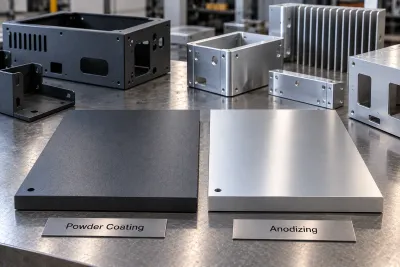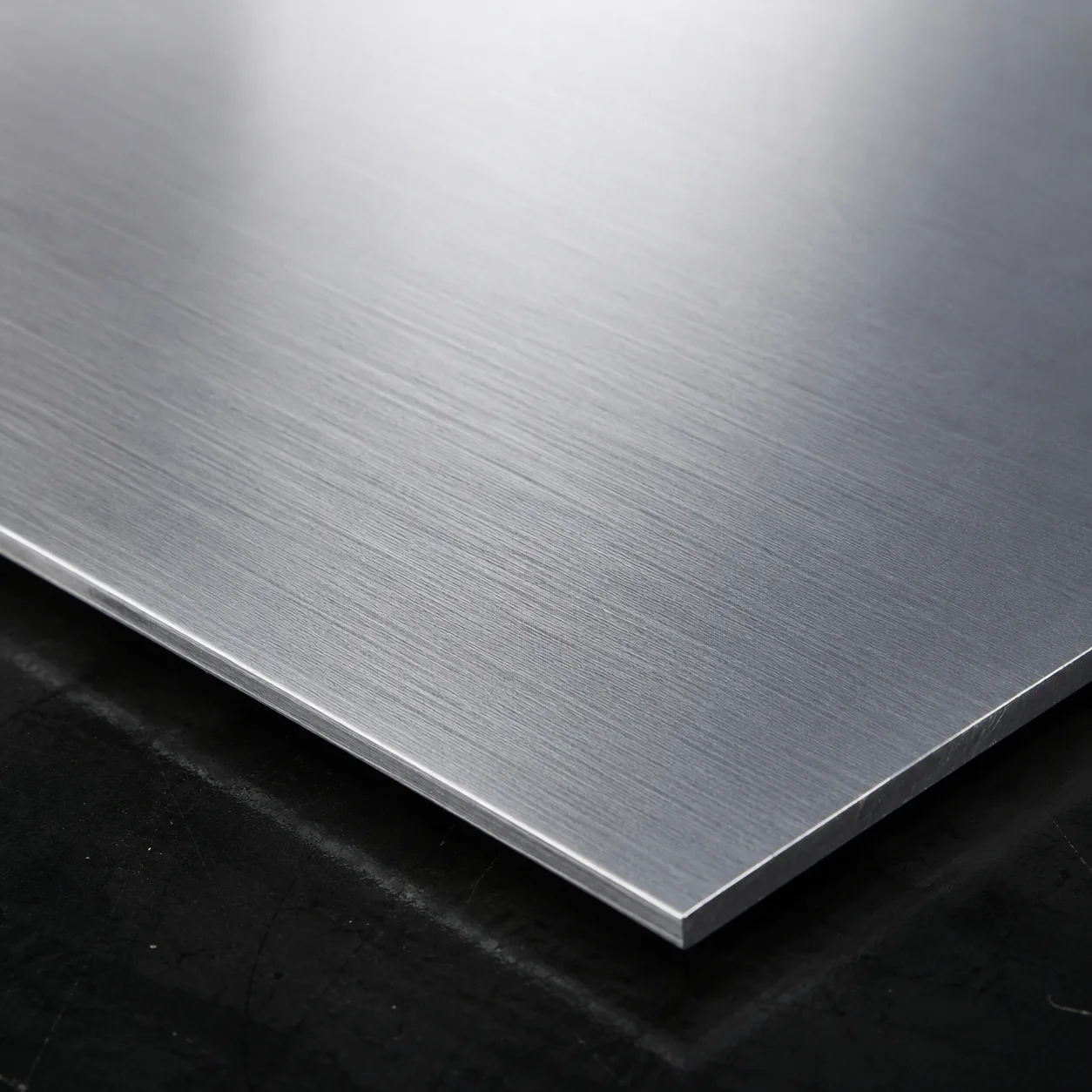
Anodizing (Standard)
Controlled artificial oxide skin grown electrochemically in sulfuric acid. Hard, wear-resistant, and ideal for color decoration.
Key Parameters
Recommended Base Materials
AL5052, AL6061 Aluminum enclosures, front panels
Pairs with these materials
What to specify on your drawing
- Type II (decorative) or Type III (hard) — they differ in thickness, wear behaviour and colour range
- Colour: clear, black or a dye reference; cross-alloy colour matching needs an agreed sample panel
- Masked areas: threads, contact points and any dimension-critical fit — anodising grows the surface
- Whether welds will be visible on anodised faces — weld zones anodise differently and should be planned, not discovered
Factory Work Sequence
Alkaline cleaning and de-smutting to expose fresh aluminum surface
Immersion in 15% sulfuric acid electrolyte at 1-2 A/dm² current density
Cold water rinsing and nickel acetate sealing to lock pores
Advantages
- Hard anodized surface (HV 300-400) approaching ceramic hardness
- Excellent corrosion resistance in salt spray testing
- Accepts dye coloring for brand-specific aesthetics
Limitations
- Only applicable to aluminum alloys (not steel, stainless, or copper)
- Dimensional build-up of 5-25 μm must be accounted for in tolerance-critical areas
Apply this finish?
Upload STEP files to our automated Estimator for custom thickness allowances and lead time quotes.
Also in this category
Anodizing converts the aluminium surface into an oxide layer rather than applying a film, typically 5–25 µm for Type II and 25–50 µm or more for Type III hard anodize. It is specified where appearance, corrosion resistance or wear resistance matters on aluminium.
Type II and Type III are different products, not grades of the same thing
Type II gives a decorative and corrosion-resistant finish that accepts dye. Type III runs longer at higher current density with tighter temperature control, producing a much harder, more wear-resistant layer that is generally darker and offers less colour latitude. Choosing between them is a durability decision, and the cost follows the process time rather than the material.
Anodizing grows the surface, so it changes fits
The oxide forms out of the substrate, so a 25 µm coating moves a surface by roughly 12 µm per side. That is irrelevant on a cosmetic panel and decisive on a press-fit bore or a mating shoulder. Mask features where the dimension is functional, or allow for the growth in the tolerance.
Why colour matching across alloys has a limit
The same dye bath does not produce the same shade on 5052 and 6061, because the alloy and temper affect how the dye is taken up. No anodizer can promise an exact match across different alloys, and that is a property of the process rather than a limitation of a particular shop. Tell us at enquiry if colour consistency across mixed alloys matters.
Sealing and the finish specification
Unsealed anodizing is porous and will absorb dye or contamination. Sealing closes the pores and is normally part of a specified finish rather than an optional extra. A drawing that states a thickness without stating whether it is sealed has left the durability of the part to the finisher.
Process type and the aluminium it suits
| Alloy | Type II | Type III | Notes |
|---|---|---|---|
| 5052 | Good — the usual choice for formed parts | Available | Best formability; clear or dyed |
| 6061-T6 | Good | Good | Colour takes differently from 5052 — cross-alloy matching has a limit |
| 3003 | Good | Limited | Soft, decorative applications |
| 7075 | Acceptable | Preferred | Hard anodize is the usual specification on high-strength grades |
| Cast / welded assemblies | Acceptable | Acceptable | Weld zones take colour differently from parent metal |
Specifications this finish is worked to
These are specifications the finish is specified against. They are not certifications held by WERIX — ISO 9001 is the only management-system certification we hold.
What to put on your drawing
- Type II or Type III, with the thickness range — the two are not interchangeable.
- Whether the finish is to be sealed.
- Colour to a standard where a dye is required, accepting a tolerance across alloys.
- Masking for threads, bores, mating faces and electrical contact areas.
- The dimensions that must survive the coating, so the growth is allowed for.
Frequently asked
Why is Type III hard anodize so much more expensive than Type II?
Because it runs longer at higher current density with tighter temperature control, and thicker coatings consume more tank time per part. You pay for process time and rack occupancy, not for material.
Will anodizing change my part dimensions?
Yes, by roughly half the coating thickness per side, because the oxide grows out of the substrate. On a 25 µm coating that is about 12 µm per surface. Allow for it on fits and bores, or mask the feature.
Can you guarantee an exact colour match across different alloys?
No, and nobody can. The same dye bath produces a different shade on 5052 and 6061 — a property of the process. Where cross-alloy consistency matters, tell us at enquiry and we will discuss what is achievable.
Do you anodize in-house?
Anodizing is coordinated with specialist finishing partners rather than run under our own roof, because the process needs its own certification structure and effluent handling. We control the specification, inspection and delivery, and we say which operations are partner-executed.
Related reading
Finish guides
Read the Anodizing guide
The specs, standards and drawing notes above give the numbers. The guide gives the reasoning behind them — how the finish behaves on the shop floor, where it fits, and where it does not.