
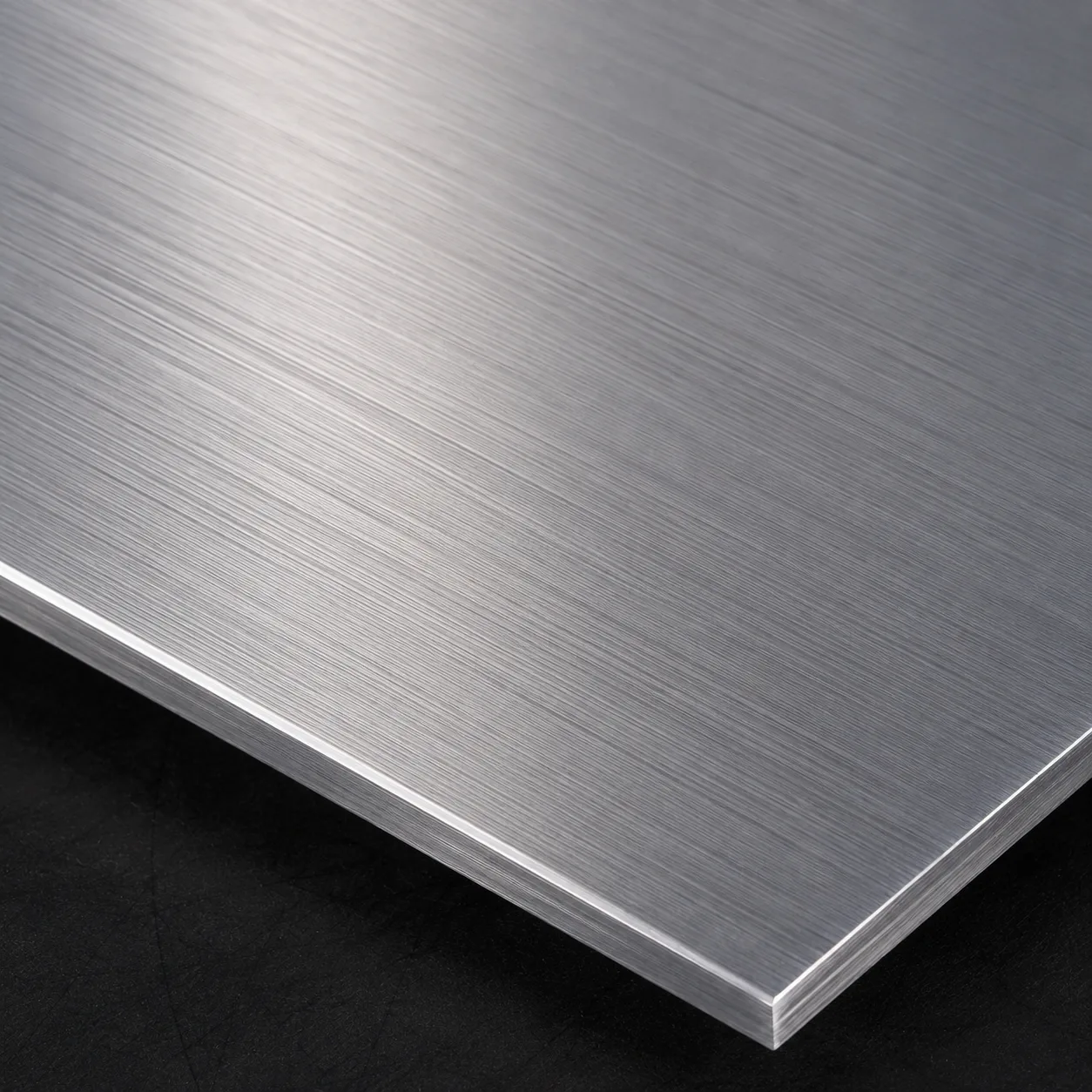
Brushed stainless steel sheet — mechanical satin line finish on SUS304
Mechanical

Mechanical Brushed (Satin Line)

Linear satin scratches formed mechanically using abrasive belts. Widely used in consumer electronics and appliance panels.

Key Parameters

Thickness
Salt Spray
Base metal rating
Wear Resistance
Medium

Recommended Base Materials

Stainless steel chassis, aluminum front panels, appliance surfaces

Pairs with these materials

What to specify on your drawing

  • Grain direction per face — horizontal and vertical brushed faces read completely differently on a cabinet
  • Which faces are cosmetic: brushed faces show handling marks, so cosmetic faces get protection through fabrication
  • No. 4 versus hairline — similar names, different look; a physical or referenced sample settles it
  • Whether welds on brushed faces are to be blended and re-grained, or left as-is

Factory Work Sequence

1

Fixturing parts on conveyor for consistent contact pressure

2

Progressive belt grinding with 180-320 grit abrasive belts

3

Post-brush passivation for stainless steel corrosion resistance

Advantages

  • Consistent directional grain pattern hides fingerprints and minor scratches
  • Low cost, fast processing, and scalable to high-volume production
  • Can be combined with clear coating for enhanced durability

Limitations

  • Directional grain must align with part geometry — cross-grain marks reject parts
  • Not suitable for deep-drawn or curved surfaces where grain uniformity is difficult

Apply this finish?

Upload STEP files to our automated Estimator for custom thickness allowances and lead time quotes.

Also in this category

Overview

Brushed finishing produces a directional satin grain by running an abrasive belt or wheel across the surface. It is the standard way to make weld dressing and handling marks disappear on stainless steel, and it produces a finish that fingerprints show less than on a polished surface.

Grain direction is part of the specification

A brushed surface has a direction. Run the grain horizontally across a panel and the eye reads a consistent line; run it in two directions on one face and the panel looks patchy under any raking light. Which way the grain runs belongs on the drawing, because it is visible in the finished product and cannot be corrected afterwards.

Hairline and No. 4 are not the same finish

A No. 4 finish is a coarser, more visible grain produced with a relatively coarse abrasive. A hairline finish is finer and produces a much subtler line. Both are commonly called "brushed", and specifying one when the customer wanted the other is a finish that cannot be reworked out — the part has to be re-finished from a coarser step.

Brushing is how weld dressing is hidden

On a visible stainless weld, the sequence is weld, dress the bead flush, then blend the dressed zone to the parent surface. A brushed grain across both makes the transition invisible. Skip the blending step and the dressed area reads as a different shade even though it is dimensionally flush, because the surface texture differs.

Where a brushed finish is the wrong answer

It is a mechanical finish on the surface, so it offers no additional corrosion protection and cannot be applied to a coated or plated part without removing the coating. On an outdoor part, brushing alone leaves the surface vulnerable at every scratch; the stainless grade has to be selected for the environment separately.

Finish specified against substrate and purpose

FinishTypical substrateCharacter
Hairline304 / 316 stainlessFine, subtle directional grain
No. 4304 / 316 stainlessCoarser, more visible grain; the industry default
Bead blastedStainless, aluminiumNon-directional matte; hides handling marks
2B mill finishStainless (as supplied)Smooth matte from the mill; no additional operation
Brushed over aluminium5052 / 6061Possible, but anodizing is usually preferred

Specifications this finish is worked to

No. 4 / hairline grain designationNamed on the drawing, since the two are not interchangeable
Grain directionSpecified per face; visible in the finished product
Blending of dressed weld zonesRequired for a flush, single-texture appearance
ISO 9001 (WERIX)Brushing is partner-executed where an industrial belt line is involved

These are specifications the finish is specified against. They are not certifications held by WERIX — ISO 9001 is the only management-system certification we hold.

What to put on your drawing

  • Which faces are brushed and which are left at mill finish.
  • The grain designation — hairline or No. 4.
  • The grain direction, per face where it differs.
  • Whether weld-dressed zones are to be blended to a single texture.
  • Whether the environment requires a further treatment over the brushed surface.

Frequently asked

What is the difference between hairline and No. 4 finish?

Grain coarseness. No. 4 is produced with a coarser abrasive and gives a more visible line; hairline is finer and subtler. Both get called "brushed" in conversation, which is why the designation belongs on the drawing rather than in an email.

Does a brushed finish improve corrosion resistance?

No. It is a mechanical surface texture and adds no protective layer. Corrosion resistance comes from the alloy, so the grade has to be chosen for the environment separately — brushing only changes how the surface looks.

Why does brushed stainless show fewer fingerprints than a mirror finish?

Because the directional grain scatters light and breaks up the reflection that makes a fingerprint visible on a polished surface. That is one of the practical reasons brushed finishes are specified on touch surfaces.

Can a brushed finish hide a weld?

It can make a dressed weld invisible if the grain is run continuously across the dressed zone, blending it to the parent metal. That requires the weld to be dressed flush first; brushing cannot hide a bead that stands proud.

Finish guides

Read the Brushed guide

The specs, standards and drawing notes above give the numbers. The guide gives the reasoning behind them — how the finish behaves on the shop floor, where it fits, and where it does not.

Read the guide
ISO 9001 · Quality Assurance

Checked at every stage

Four-step quality control from raw material to shipment. Precision inspection at every stage. FAI reports provided on request.

WERIX Metal is certified to the ISO 9001 quality management standard.

3,000+ m²
manufacturing space
11+
years
5,000+
clients served
24 h
quote reply
01

Incoming Material

Each batch of raw sheet metal checked for thickness, grade, and surface finish before production begins.

02

In-Process Check

First-article inspection and random sampling at every workstation: laser, bend, weld, stamp.

03

Final Inspection

Dimensions checked against customer drawings. Precision instruments used for tight-tolerance parts.

04

Shipment Audit

Packaging, labeling, and surface protection inspected before dispatch. Each batch traced.

Frequently asked questions

Which sheet metal finishes can I order through WERIX?

Powder coating, anodizing (Type II and hard Type III), zinc plating, hot-dip galvanizing, passivation, electropolishing, brushing, bead blasting, chromate conversion and silk-screen printing. Finishing is carried out by long-standing licensed partner plants to our specification, inspected by us, and placed on the same purchase order — one order, one shipment, one point of accountability. See the full finishes overview.

Powder coating or anodizing — which should I specify?

Powder coat builds a 60–120 µm film and suits steel and aluminium where colour matching and texture matter. Anodizing is an aluminium-only conversion layer of 5–25 µm that keeps the metal look and barely changes dimensions, so it is the better choice for tight-tolerance aluminium parts and wear surfaces. Steel parts cannot be anodized.

What coating thickness and salt-spray performance can you hold?

Standard polyester powder coat runs 60–120 µm with 500–1,000 hours salt spray depending on pretreatment; hot-dip galvanizing gives a zinc layer of 70 µm or more; Type II anodizing is 10–25 µm. Thickness is measured and recorded per batch, and readings can be supplied with the shipment.

Which finishes are suitable for outdoor use?

Outdoor polyester powder coat over phosphate pretreatment, hot-dip galvanizing, and Type II anodizing with UV-stable sealing all perform outdoors. Matte or textured surfaces hide handling marks better than gloss, which matters once parts are stored on site before installation.

Can you match a specific RAL or Pantone colour?

Yes. RAL is standard and matched against a retained sample; Pantone references are matched to the closest powder equivalent. We keep a retained panel for each project so a repeat order years later still matches the original shipment.

Which metal finish is best for outdoor use?

Outdoor polyester powder coat over phosphate pretreatment, hot-dip galvanizing, and Type II anodizing with UV-stable sealing all perform outdoors. Matte or textured surfaces hide handling marks. Compare options in the powder vs anodizing guide guide.

Can WERIX match a RAL or Pantone colour?

Yes. RAL is standard and matched against a retained sample; Pantone is matched to the closest powder equivalent, and we keep a retained panel per project so repeat orders match years later. See the powder coating page for the process and batch notes.

What finish should I specify for aluminium?

Anodizing keeps aluminium's metallic look and changes dimensions only 5-25 um, so it suits tight-tolerance and wear surfaces; powder coating gives thicker colour protection but hides the substrate. The choice depends on fit and appearance - our anodizing guide explains both.

Do you offer laser engraving on finished parts?

Yes. Laser engraving marks logos, serials and part numbers directly on the metal or on a coated surface, with no ink to wear off - useful for traceability and branding. Send the artwork and we will confirm mark depth and contrast on your finish.

Powder coating, anodizing or zinc plating — which lasts longest outdoors?

For steel outdoors, hot-dip galvanizing (45–200 µm zinc, 1,000–2,000 h salt spray) under a powder topcoat is the most durable because the zinc protects sheared edges the coating cannot reach. For aluminium, Type II anodizing with UV-stable sealing (10–25 µm) performs well and keeps the metal look. Powder coat alone (60–120 µm, 400–1,000 h) is the colour and texture choice but relies on the substrate. Compare the options in our powder vs anodizing guide.

Can you combine two finishes on one part?

Yes. Common combinations are anodizing with laser engraving for part numbers, powder coating with masked threads or mating faces left bare, and zinc plating with a clear passivation for cosmetic fasteners. Tell us which surfaces must stay uncoated and we mask them before finishing. See the powder coating and anodizing process pages for what each process covers.

Powder coating or liquid (wet) paint — which should I specify?

Powder coating is the default for sheet metal: it builds a uniform 60–120 µm film with no solvent, resists chipping better than wet paint, and the overspray is reclaimed, so it is also the greener choice. Liquid (wet) paint is reserved where a specific automotive or appliance spec demands it, or for touch-up and very large parts that will not fit the cure oven. Both are applied by our licensed partner plants to specification and inspected by us. Compare powder with anodizing in our powder vs anodizing guide.