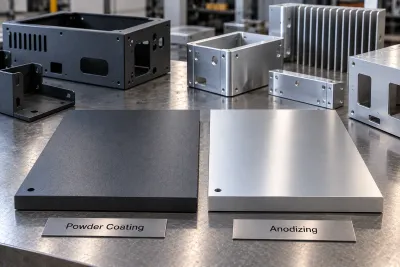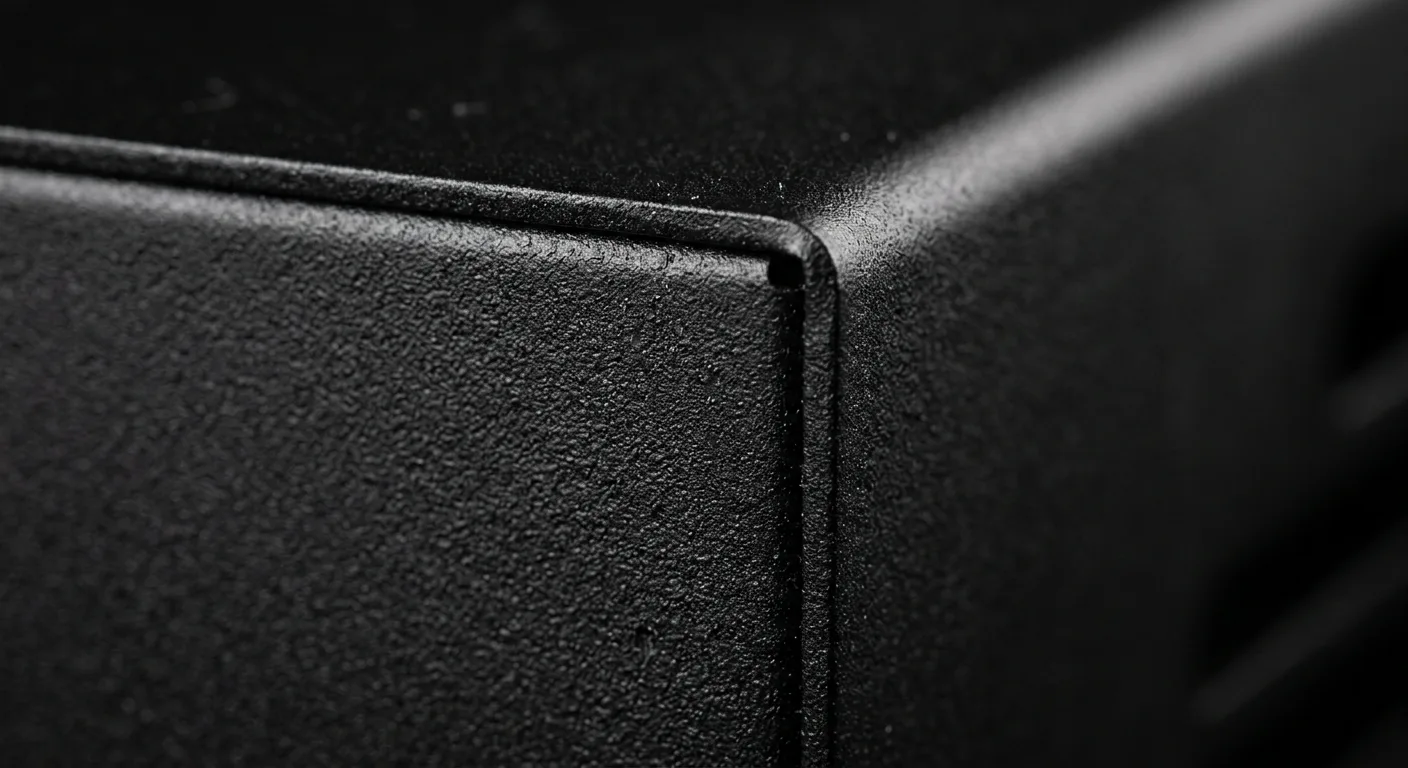
Powder Coating (Satin / Matte)
Electrostatic powder spray application cured under thermal heat. Delivers a tough, chip-resistant protective outer skin with hundreds of RAL code options.
Key Parameters
Recommended Base Materials
SPCC Carbon Steel, Heavy brackets, electrical cabinets
Pairs with these materials
What to specify on your drawing
- Colour by RAL or Pantone code, plus the gloss level (matte, satin or gloss) — "black" alone is not a specification
- Masking requirements for threads, grounding points, hinge mating surfaces and any dimension-critical area
- Which faces are cosmetic (film builds can telegraph surface marks — cosmetic faces get stated, not assumed)
- Film build expectation as a range, if the duty calls for one — confirmed per project rather than assumed
Factory Work Sequence
Multi-stage chemical pretreatment: alkaline degreasing, acid pickling, and phosphate conversion coating
Dry-off oven to prevent outgassing and blistering defects during curing
Electrostatic powder spray in fully ventilated cyclone spray booths
180-200°C convection oven curing for 10-20 minutes to cross-link the polymer molecules
Advantages
- Highly impact-resistant and chip-resistant protective shell
- Covers minor laser heat marks, welding spots, and metal scratches
- Environmentally friendly (solvent-free, near-zero VOC emissions) polymer formulation
Limitations
- Significant coating thickness (60-120 μm) may interfere with close tolerance threads or hinges
- Cannot be applied selectively to internal cavities without specialized manual masking
Apply this finish?
Upload STEP files to our automated Estimator for custom thickness allowances and lead time quotes.
Also in this category
Powder coating is an electrostatic polymer film cured at temperature, typically 60–120 µm thick, giving the toughest chip-resistant finish on sheet metal. It covers laser heat marks and weld dressing, takes hundreds of RAL colours, and is the default exterior finish for steel enclosures.
Why pretreatment decides whether the coating survives
Powder bonds to a prepared surface, and preparation means degreasing plus a conversion coating matched to the substrate. Bare cold-rolled steel takes a phosphate layer; galvanised and zinc-coated steel need different chemistry, because the zinc surface behaves differently and the wrong sequence produces blistering that appears months later rather than at inspection.
Where a powder film interferes with function
A 60–120 µm film is a real dimensional change. It closes a thread, changes a press fit, fills a gasket groove and insulates an earth path. Every such feature has to be masked, and masking is a drawing decision — a part that needed four masks instead of one was designed that way, not finished that way.
Colour, batch minimums and how to buy it efficiently
A standard RAL shares the line with other work; a matched bespoke colour needs its own batch, and the setup costs the same whether the batch is ten parts or a thousand. The practical saving is to consolidate parts onto one standard colour per run rather than to negotiate a lower rate.
Is powder coating the right finish here?
It is the wrong choice for close-tolerance bores, moving interfaces, sliding contacts and electrical grounding faces, because the film changes the fit or breaks the path. For aluminium parts wanted in their metallic appearance it hides the substrate rather than enhancing it, and anodizing is usually the better answer.
Substrate suitability and the pretreatment it implies
| Substrate | Pretreatment | Notes |
|---|---|---|
| Cold-rolled steel (SPCC) | Degrease + phosphate conversion | The straightforward case; cut edges unprotected |
| Galvanised / zinc-coated (SGCC, SECC) | Degrease + zinc-matched conversion | Different chemistry from bare steel; skipping it causes blistering |
| Stainless 304 / 316 | Degrease + adhesion promoter | Coated for colour, not for corrosion protection |
| Aluminium 5052 / 6061 | Degrease + chromate conversion | Conversion layer required before powder for adhesion |
| Copper / brass | Degrease + adhesion promoter | Usually coated for appearance; plating is often the better route |
Specifications this finish is worked to
These are specifications the finish is specified against. They are not certifications held by WERIX — ISO 9001 is the only management-system certification we hold.
What to put on your drawing
- Colour to a RAL or Pantone reference, with the finish type — gloss, satin, matt or textured.
- Film thickness range where the environment or a customer specification demands one.
- Which faces are cosmetic class A and which may be coated freely.
- Explicit masking for threads, bores, gasket lands, mating faces and earth points.
- Whether a conversion coating is required where the substrate demands it.
Frequently asked
How thick is a powder coat, and does the thickness matter?
Typically 60–120 µm per applied face. It matters wherever a dimension is functional: a masked thread, a gasket groove, a press fit or an earth stud. Tell us those features and we will mask them; discovering it after coating means rework.
Can you match an existing painted part?
Usually, from a physical sample or a colour reference. Send the part or the RAL code and we will confirm what is achievable and whether a bespoke batch is required, because that decision changes both price and lead time.
Does powder coating protect cut edges?
It covers them, but a coating is a barrier rather than a sacrificial layer, and a cut edge is where a barrier fails first under impact. A zinc-coated substrate under the powder gives the sheared edges sacrificial protection that coating over bare steel cannot.
Why is a bespoke colour more expensive than a standard RAL?
Because a matched colour has to be made up and the line set up for it specifically, and that setup is the same for a small batch as a large one. A standard RAL already in the schedule shares setup with other work.
Related reading
Finish guides
Read the Powder coating guide
The specs, standards and drawing notes above give the numbers. The guide gives the reasoning behind them — how the finish behaves on the shop floor, where it fits, and where it does not.