
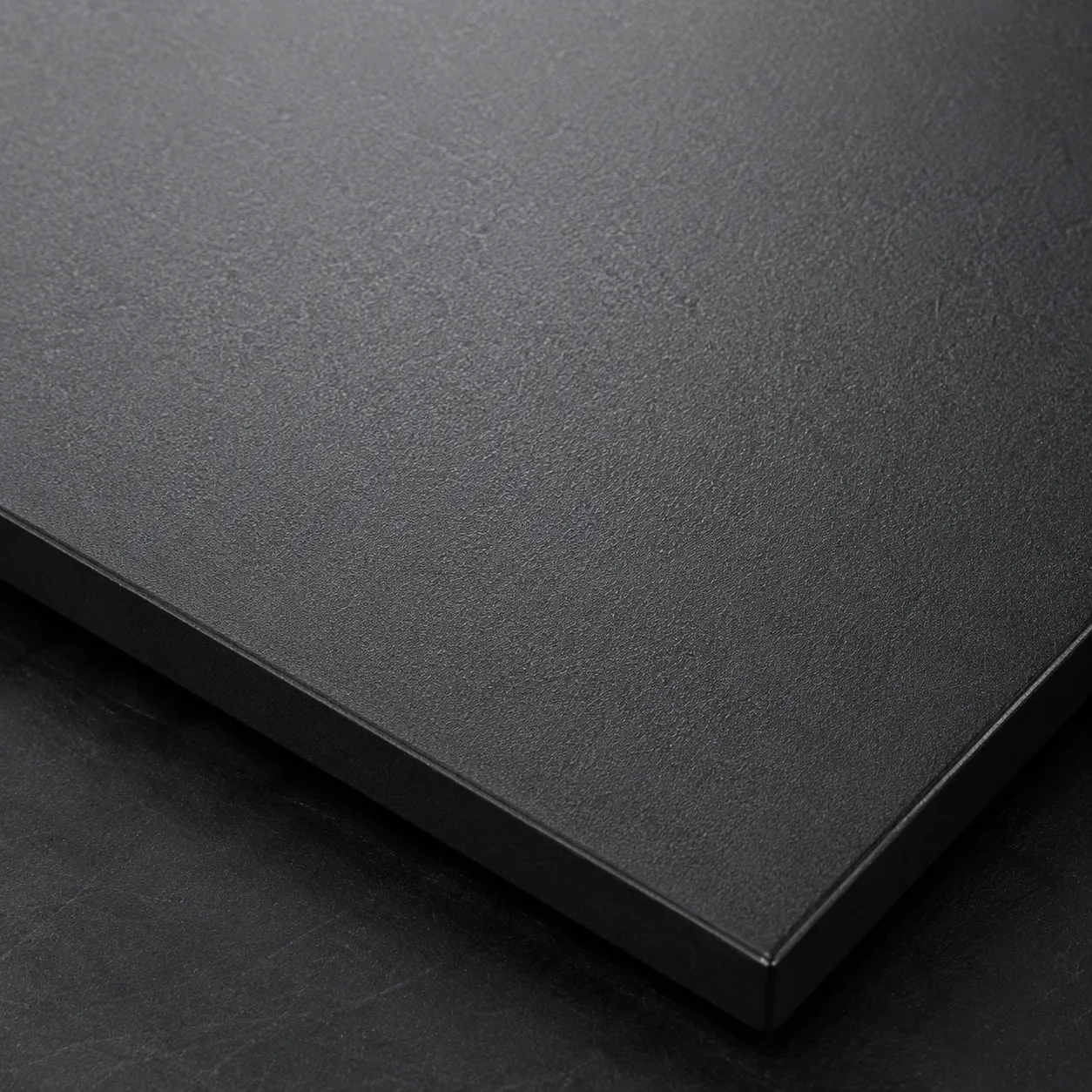
Sandblasting (Matte Texture)
High-pressure abrasive media impacts surface to create uniform matte texture. Removes scale, rust, and prepares for coating.
Key Parameters
Recommended Base Materials
Pre-treatment for powder coating, decorative matte finish on aluminum
Pairs with these materials
What to specify on your drawing
- Media intent: glass bead (uniform matte, the common request) versus coarser abrasive media — they produce different textures
- Which faces are cosmetic, and whether parts are blasted before or after forming (sequencing changes edge appearance)
- Whether blasting precedes anodising or coating — pre-finish blasting is the standard route for uniform matte results
- Masking for dimension-critical or decorative regions that must keep their as-formed surface
Factory Work Sequence
Media selection: glass bead for peening, aluminum oxide for etching
Pressure regulation at 2-4 bar for consistent coverage
Post-blast cleaning with compressed air and degreasing
Advantages
- Creates uniform matte texture that improves coating adhesion
- Effectively removes mill scale, rust, and welding discoloration
- Versatile media options (glass bead, aluminum oxide, steel grit) for different textures
Limitations
- Dust generation requires enclosed booths and extraction systems
- Surface roughness variation depends on operator skill and media consistency
Apply this finish?
Upload STEP files to our automated Estimator for custom thickness allowances and lead time quotes.
Also in this category
Bead blasting propels fine glass or ceramic beads at the surface to produce a uniform, non-directional matte finish. Unlike sand, which cuts, beads peen the surface — so the finish is softer, has no grain direction, and hides handling marks and tooling witness marks exceptionally well.
Bead blasting and sandblasting are genuinely different processes
Sand is an abrasive and cuts the surface, leaving a coarser, more aggressive profile and, on stainless, embedding contamination that can seed corrosion. Glass or ceramic bead is round and peens rather than cuts, producing a finer, denser matte with no embedded residue. The two get conflated in conversation, and specifying the wrong one is a finish problem that shows up as rust spotting on stainless.
Why there is no grain direction
Because the media is thrown at the surface from many directions rather than run along it. The result is a uniform matte that reads identically from any viewing angle, which is exactly why it is chosen on parts where a directional finish would look patchy across a complex formed shape.
What bead blasting is genuinely good at hiding
Tooling witness marks, small handling scratches and the dulling that follows a welded and dressed zone. It sits between a full polish and a mill finish in both appearance and cost, and on aluminium it is often used as a preparation step before anodizing rather than as the final finish.
Media discipline on stainless
A blasting cabinet that has previously run carbon steel will contaminate stainless with iron particles, and those particles rust on the finished part. Stainless blasting therefore needs its own media and ideally its own cabinet. This is a process discipline rather than a specification, which means it is worth asking about explicitly.
Blasting media and what each produces
| Media | Action | Typical result |
|---|---|---|
| Glass bead | Peening | Fine uniform matte; the default decorative blast |
| Ceramic bead | Peening | Longer media life; similar finish, more consistent over time |
| Aluminium oxide | Cutting | Coarser profile; used for adhesion preparation rather than appearance |
| Sand / silica | Cutting | Coarser finish, residue risk on stainless — avoid on corrosion-critical parts |
| Bead + anodize | Peening then conversion | Matte anodised appearance on aluminium |
Specifications this finish is worked to
These are specifications the finish is specified against. They are not certifications held by WERIX — ISO 9001 is the only management-system certification we hold.
What to put on your drawing
- The media — bead, ceramic bead or abrasive — not simply "blasted".
- Which faces are blasted and which are protected.
- The Ra value where a measurable surface roughness matters.
- Whether the blasting is the final finish or a preparation for anodizing or coating.
- That stainless is blasted with dedicated media, if the part is corrosion-critical.
Frequently asked
Is bead blasting the same as sandblasting?
No. Bead is round and peens the surface; sand is angular and cuts it. Bead produces a finer, denser matte and leaves no embedded residue, which matters on stainless where sand can contaminate the surface and seed corrosion.
Can bead blasting hide scratches?
It hides fine handling scratches and tooling witness marks well, because the texture is non-directional and breaks up the light. It will not hide a deep score or a gouge, and it cannot remove a dimensional defect.
Does bead blasting affect the material properties?
The peening action introduces compressive stress at the surface, which is a surface effect rather than a bulk change. The part dimensions are essentially unaffected at the media and pressure used for decorative finishing.
Why does blasted stainless sometimes rust?
Contamination. A cabinet previously used on carbon steel leaves iron particles embedded in the surface, and those rust. Stainless needs dedicated media and ideally a dedicated cabinet, and it is worth asking a supplier directly whether they do this.
Related reading
Finish guides
Read the Bead blasting guide
The specs, standards and drawing notes above give the numbers. The guide gives the reasoning behind them — how the finish behaves on the shop floor, where it fits, and where it does not.