
Precision engineered, built in-house, shipped worldwide
Every component laser-cut, bent and welded on our floor in Dongguan, and finished under the same inspection.
Selected Works
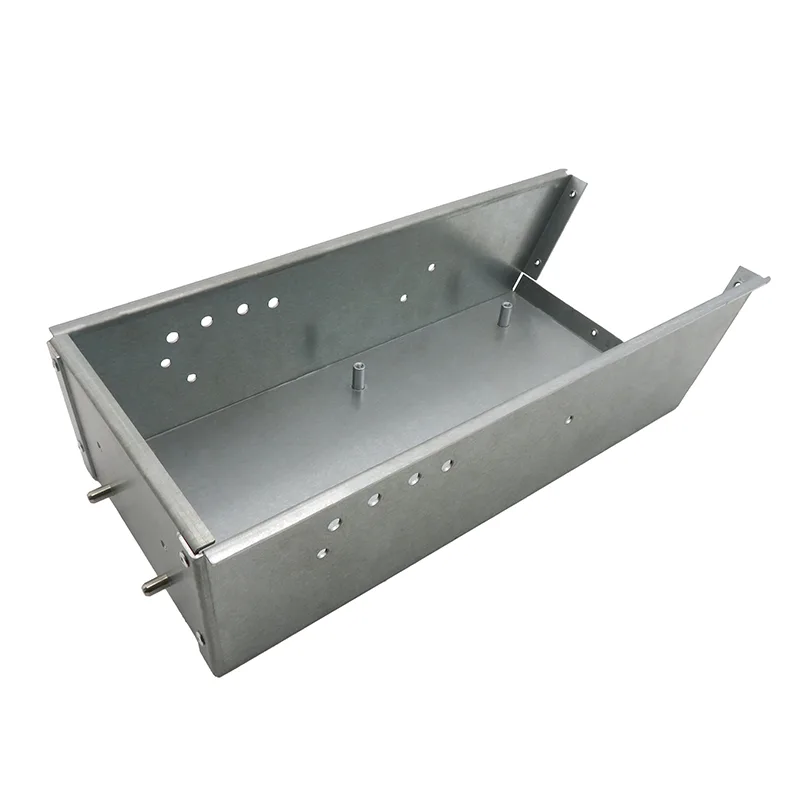
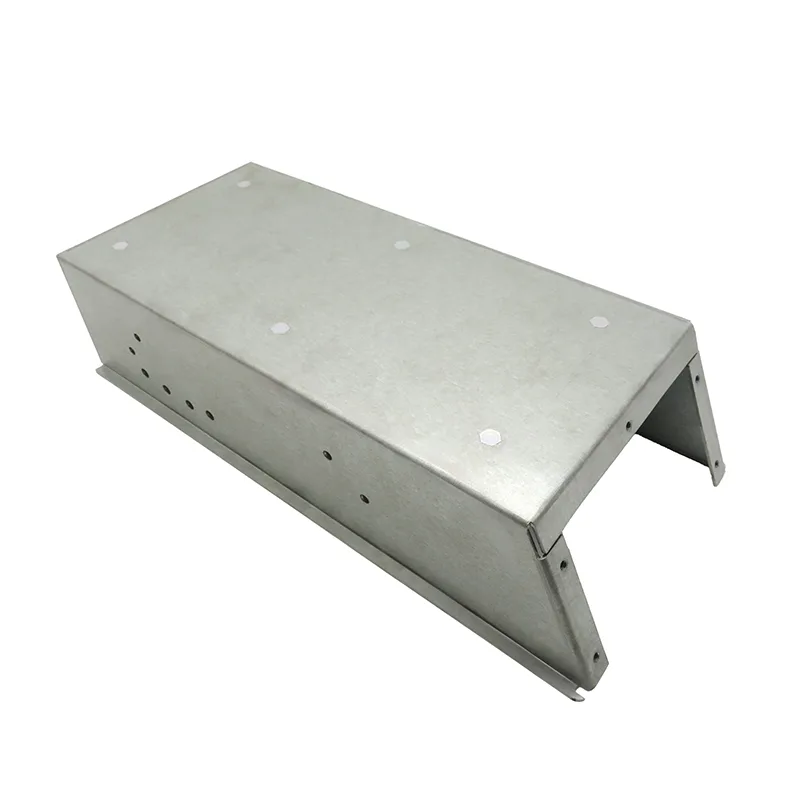
AGV Battery Tray
Reinforced battery tray for AGV and mobile robot platforms. Raised edge lips prevent battery migration. Multiple tie-down points.
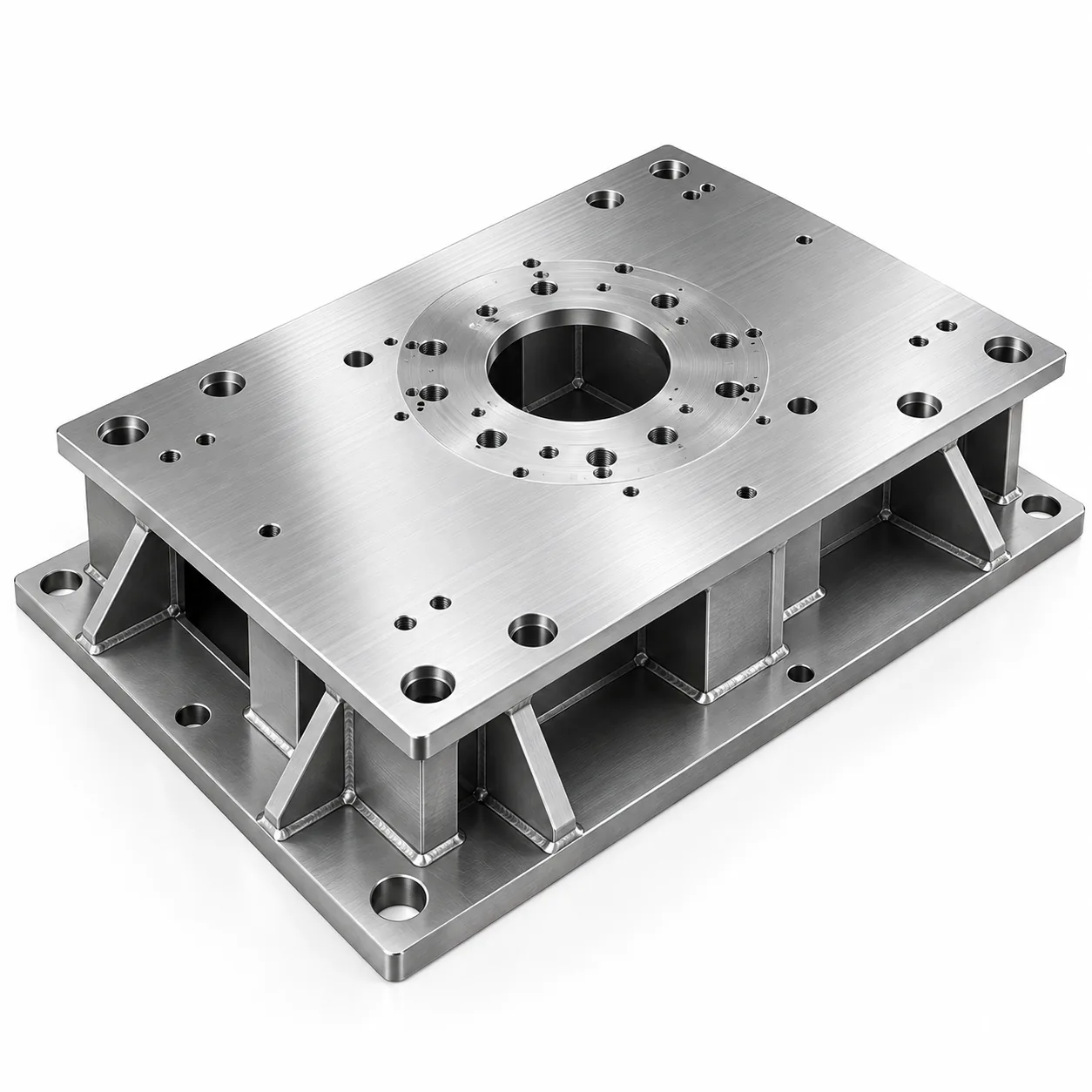
Robot Cell Mounting Plate
Welded robot pedestal plate, roughly 1,200 × 800 mm, built from 8 mm plate and 6 mm stiffening ribs. The robot interface and its bolt pattern are machined in one setup after stress relief, so the mounting face is flat and stays flat in service.
AGV / AMR Chassis Frame — Stiffness per Kilogram
Load-bearing chassis frame for automated guided vehicles and autonomous mobile robots: formed steel or aluminium sections, machined drive-unit mounting faces, and a rib layout that keeps the deck flat under a 500 kg payload without adding wall thickness everywhere.
Industrial Robot Arm Housing & Covers
Axis covers and joint housings for industrial robot arms, formed to follow the arm profile with cable routing inside the cover and fastener positions that stay reachable in every joint position — the difference between a cover that is maintained and one that is left off.
Drone Frame Plate & Body Panel — CNC & Formed
Structural plates and body panels for UAVs: carbon-steel or aluminium plates with pocketed lightening, press-fit inserts at motor and payload stations, and arm-mount faces machined flat so propeller alignment does not depend on the frame’s tolerance stack.
Cobot Base & Mounting Frame — Collaborative Robot
Base plate and mounting frame for collaborative robots: 8–12 mm steel or aluminium plate, tapped bolt pattern matched to the cobot flange, levelling feet or anchor holes, and a cable pass-through that keeps the harness from being pinched during rotation.
All Robotics & Drones sheet metal parts
- AGV Battery Tray
- Robot Cell Mounting Plate
- AGV / AMR Chassis Frame — Stiffness per Kilogram
- Industrial Robot Arm Housing & Covers
- Drone Frame Plate & Body Panel — CNC & Formed
- Cobot Base & Mounting Frame — Collaborative Robot
- Robot Control Cabinet
- Robot Teach Pendant Housing — Handheld
- LiDAR & Sensor Mounting Bracket — Calibrated
- Service Robot Chassis
- Drone Motor Mount & Landing Gear
Specifications we produce
- Material
- SGCC galvanized steel 2.0mm · S355 steel 8.0mm base + 6.0mm ribs · SPHC 3.0-6.0mm / AL5052 3.0mm · AL5052-H32 1.5mm · AL7075-T6 1.5-2.0mm / carbon fiber · AL6061-T6 5.0-10mm · SPCC 1.5mm / AL5052 1.2mm · AL6061-T6 3.0mm · AL6061-T6 3.0mm / AL5052 2.0mm · AL5052-H32 2.0-3.0mm · AL7075-T6 2.0mm / AL6061-T6 3.0mm
- Tolerance
- ±0.1mm · ±0.1mm on the machined interface
- Manufacturing processes
- Laser Cutting · CNC Bending · Powder Coating · MIG Welding · Stress Relief · CNC Machining · laser cutting · CNC bending · MIG welding · CNC machining · precision laser · riveting · CNC milling · drilling · tapping · hardware insertion · anodizing · CNC machining or precision laser cutting · spot welding
- Surface Finish
- Zinc plated · Machined interface, primer on the fabricated faces · powder coat or anodizing · anodizing Type III hard coat · hard anodizing Type III · powder coat RAL 7035 · hard anodizing Type III + rubber overmold · anodizing Type II · powder coat + rubber feet
Robotics and drone sheet metal: stiffness per gram
Robotics and drone structures are weight-budgeted. Every bracket is judged on stiffness-to-mass, every cover on whether it earns the grams it adds, and the parts move — so resonance and fatigue matter as much as static strength. Sheet metal is good at this: a formed rib adds stiffness for almost no weight.
The sector also iterates fast. Prototype quantities of one design get replaced by a revised version within weeks, so the ability to produce five parts without tooling and five thousand with tooling — on the same drawing — is the real requirement.
- Typical robotics and drone parts we manufacture
- AGV/AMR chassis plates and battery trays
- Robot arm covers and cable-management shells
- Drone frames and motor mounts
- Control cabinet plates and mounting plates
- Sensor brackets and shields
- Ribs before gauge
- Adding material thickness everywhere is the expensive answer. A rib in the load direction, or a flange that turns a flat plate into a section, usually achieves the stiffness target at lower mass and lower cost. We run that comparison during the DFM review.
- Cable paths are metal features
- Moving joints need cable clearance through the full range of motion. Radiused edges, clip features and formed channels in the cover keep harnesses away from pinch points — details that are much easier to form than to add as plastic parts later.
- Resonance shows up in service, not on the bench
- A cover panel that is quiet at standstill can act as a drum at operating speed. Light stiffening, contact damping or a change in panel span resolves it — and it is worth asking about the operating speeds before the design is frozen.
- Material and finish choices for robotics structures
- Aluminium 5052 and 6061 for weight-critical plates and frames; SPCC/SGCC where the part is internal or cost-driven; 304 stainless for cleanroom or washdown variants. Anodising for abrasion and electrical isolation, powder coat where colour coding or branding applies, and conductive finishes where shielding or earthing is required.
- Quality records robotics buyers ask for
- Dimensional reports against the datum, mass verification (many customers weigh parts as an incoming check), flatness on mounting faces, and material certificates. Batch traceability matters for field service: a bracket supplied three years later must match the fleet it is being fitted to.
What we make, not just who for
Enclosures, cabinets, chassis, brackets, panels and frames — with the design constraints each one comes with.
Sheet metal engineering guides
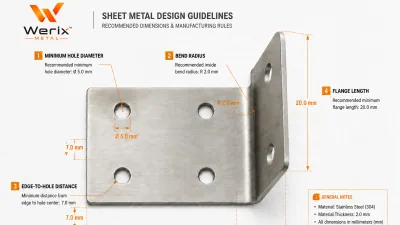 DFM for Sheet Metal: Essential Design Rules That Save Cost and Prevent Production FailuresDesign-for-manufacturing rules for sheet metal — minimum hole sizes, bend radii, edge distances, tab-and-slot design, and common mistakes that cause scrap.Read More
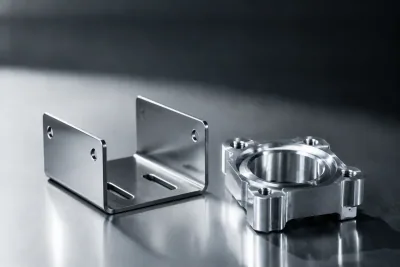 Sheet Metal Fabrication vs CNC Machining: How to Choose the Right ProcessSheet metal fabrication and CNC machining serve different geometries, volumes, and budgets. This data-backed comparison covers cost, tolerance, materials, and lead time.Read More
Have a custom part in mind?
Upload your product files or describe your specs — our engineers will return a quote with material, process, and cost details within 24 hours.