SUB-PROCESS 06 — CNC Sheet Metal

Manual TIG Welding

Master welders perform precision TIG (Tungsten Inert Gas / GTAW) welds on stainless steel, aluminum, and copper alloys. TIG produces the cleanest, most visually refined weld bead among all arc processes — zero spatter, no slag, smooth 'stacked-dime' profile. It is the default choice when weld appearance, food-grade hygiene (welds produced to AWS D18.1 practice, Ra ≤ 0.8 μm), or radiographic inspection is required.
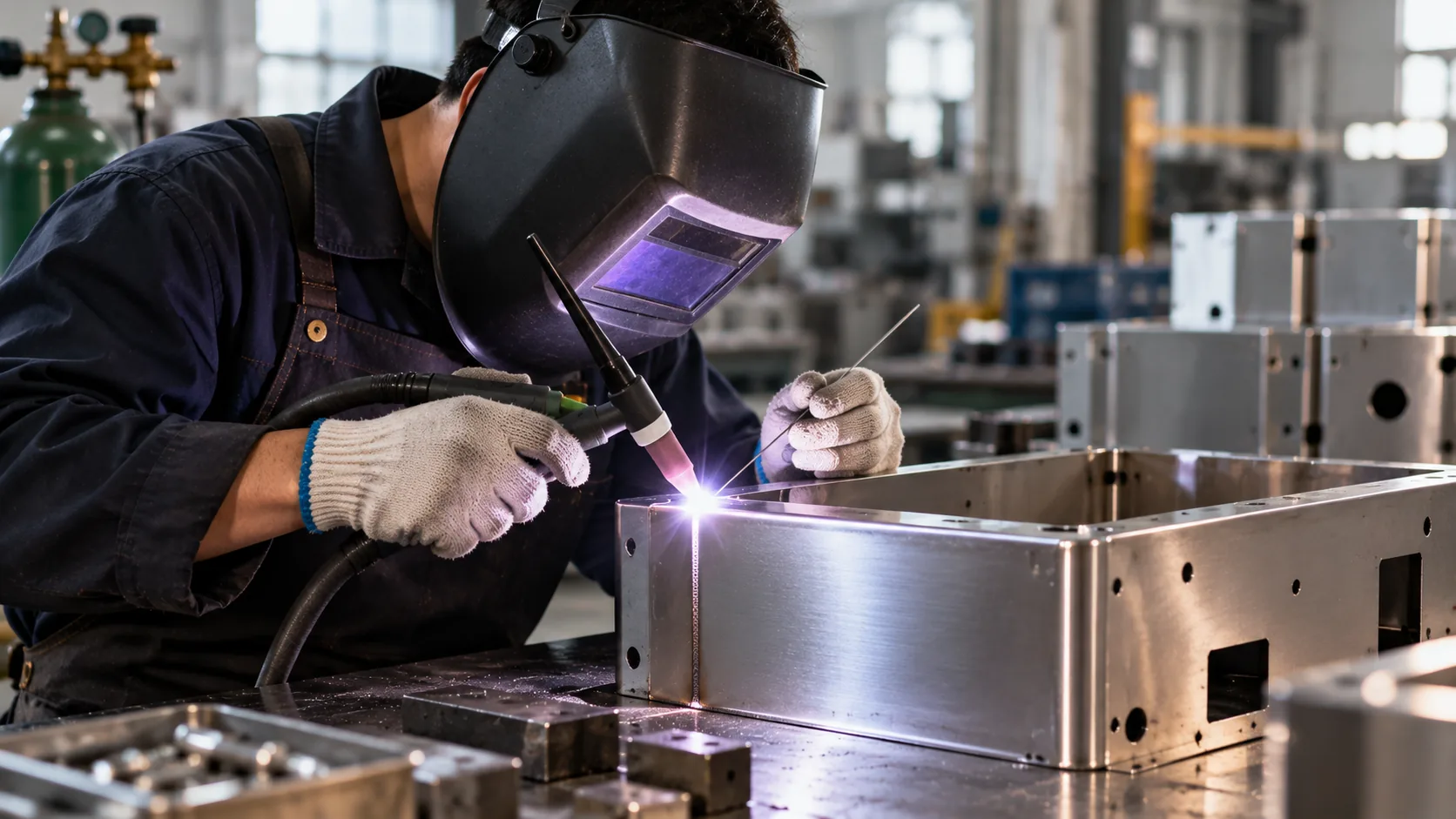
Manual TIG welding on stainless steel enclosure — precision arc welding
Overview

TIG welding joins sheet metal with a non-consumable tungsten electrode and a separate filler rod under argon shielding. It gives the cleanest, most controllable weld of any process we run, with minimal spatter and a narrow heat-affected zone, which makes it the default choice for stainless enclosures, food-grade assemblies and visible cosmetic seams.

When should I choose TIG over MIG?

Choose TIG on thin material, on stainless and aluminium, and wherever the seam will be visible or has to be leak-tight. It is slower and more operator-dependent than MIG, so it costs more per metre of weld. On structural steel 3 mm and thicker with no cosmetic requirement, MIG is the cheaper and faster option.

How do you control distortion on thin sheet?

Distortion comes from heat input, so we control it with a tight fit-up, low amperage, short stitch welds in a balanced sequence and copper or aluminium backing as a heat sink. Where a panel must stay flat, we weld in a fixture and, if needed, planish and re-check flatness before finishing.

TIG vs MIG vs laser welding on sheet metal

FactorTIGMIGLaser
Material thickness0.5–6 mm1.5 mm and up0.2–3 mm
Weld appearanceBest — cosmetic seamsGood, needs dressingExcellent, minimal marking
Heat input / distortionLowHighVery low
SpeedSlowestFastFastest
Best forStainless, aluminium, cosmeticStructural steel, thick plateThin sealed enclosures

Common questions about Manual TIG Welding

Can TIG welds be ground and polished flush?

Yes. TIG produces a clean bead with no spatter, so grinding back to a flush seam and brushing to a matching grain is straightforward. On stainless enclosures we routinely finish seams to a #4 brushed direction so the weld line disappears into the surrounding surface.

Do TIG welded stainless parts still resist corrosion?

They do if the weld is properly shielded and the heat tint is removed. We back-purge or use shielding on the root where the weld is exposed to product contact, then passivate or electropolish the assembly to restore the chromium oxide layer across the weld zone.

Is TIG welding suitable for a sealed IP-rated enclosure?

It is the standard approach for IP65–IP67 enclosures. We weld continuous seams rather than stitches, then verify with a leak or spray test appropriate to the rating. Tell us the target IP rating at RFQ stage so the weld sequence and gasket design are planned together.

Specifications

MaterialsSUS304, SUS316, AL5052, AL6061, Copper
Thickness Range0.3mm – 5.0mm
Weld QualityX-ray and dye-penetrant inspectable
Joint TypesButt, lap, fillet, corner, edge

Capabilities

Cleanest weld bead — zero spatter, no slag
Full penetration with argon back-purge
Food-grade / sanitary weld practice to AWS D18.1
Manual precision on complex joints

TIG vs Other Welding Methods

Multi-parameter comparison to help you choose the right joining method for your application.

ParameterTIG (GTAW)MIG (GMAW)Spot (RSW)Laser
Welding SpeedSlow — manual pace, 50–300 mm/minModerate — 1000–3000 mm/minVery fast — 0.1–0.5 s/spotVery fast — 10–5000 mm/min
HAZ WidthNarrow — 1–2 mmModerate — 3–5 mmVery narrow — <1 mmUltra-narrow — <1 mm
DistortionLowModerateVery lowMinimal
Filler MaterialOptionalRequiredNoneNone
AutomationManual / semi-autoSemi-auto / autoFully automatedFully automated
AppearanceExcellent — smooth stacked-dime beadGood — minor ripplesLimited — spot marks onlyExcellent — cosmetic seam
Best ForFood-grade, sanitary, visible jointsHigh-speed structural weldsHigh-volume sheet assembliesPrecision enclosures, thin-wall parts

Ready to get started?

Upload your design for a quote with DFM analysis — our engineers respond within 24 hours.

ISO 9001 · Quality Assurance

Checked at every stage

Four-step quality control from raw material to shipment. Precision inspection at every stage. FAI reports provided on request.

WERIX Metal is certified to the ISO 9001 quality management standard.

3,000+ m²
manufacturing space
11+
years
5,000+
clients served
24 h
quote reply
01

Incoming Material

Each batch of raw sheet metal checked for thickness, grade, and surface finish before production begins.

02

In-Process Check

First-article inspection and random sampling at every workstation: laser, bend, weld, stamp.

03

Final Inspection

Dimensions checked against customer drawings. Precision instruments used for tight-tolerance parts.

04

Shipment Audit

Packaging, labeling, and surface protection inspected before dispatch. Each batch traced.

Frequently asked questions

What sheet metal capabilities does WERIX offer?

WERIX runs the full sheet-metal and stamping process chain on our own floor: fiber laser cutting (±0.1mm), CNC bending (±0.5°), TIG/MIG/spot/laser welding, progressive die stamping (±0.01mm), deep drawing and assembly — plus powder coating, anodizing and plating at long-standing licensed partner plants to our specification. Full process list on the capabilities overview.

Does WERIX handle both sheet metal fabrication and metal stamping?

Yes. WERIX is one of few factories offering both sheet metal fabrication (laser cut + bend) and metal stamping (progressive die, transfer die) under one roof with an in-house die workshop.

What tolerances can WERIX achieve?

Laser cutting: ±0.1mm. CNC bending: ±0.5° (±0.1° on new machines). Stamping: ±0.01mm with progressive dies. Welds for food-grade surfaces are produced to AWS D18.1 practice.

Can WERIX produce both a prototype and the production run?

Yes. Prototypes are laser cut and bent with no tooling cost, then the same part moves to turret punching or progressive die stamping once volume justifies the die. One factory, one quality system and one engineering contact cover every stage.

What is the maximum sheet metal size and thickness you can process?

Fiber laser cutting handles sheet up to 5 mm in production and 25 mm at reduced speed; CNC bending supports part lengths up to 3,100 mm on the TOPSEN bed, and holds ±0.1° on parts up to 2,200 mm through the precision cell; turret punching covers sheet up to 6 mm. Tell us the part envelope and we will confirm machine fit.

Do you offer surface finishing and assembly in the same order?

Yes, on one purchase order. Hardware insertion, welding, gasket fitting and functional testing are done in-house; powder coating, anodizing, plating, brushing, sandblasting, silk printing and laser engraving are carried out by long-standing licensed partner plants to our specification and inspected by us. You deal with one supplier instead of five.

Is WERIX ISO 9001 certified?

Yes. WERIX Metal is ISO 9001 certified. The quality management system covers incoming material inspection, in-process control at every workstation, final inspection against your drawing and the shipment audit.

Which welding processes does WERIX offer?

WERIX offers TIG, MIG, spot and laser welding, all performed in-house on the same floor as cutting and bending. Spot and laser welding suit thin-gauge enclosures; TIG gives clean cosmetic seams on visible brackets. See the laser welding and TIG welding process pages for tolerances and typical parts.

Do you build and maintain stamping dies in-house?

Yes. Our in-house die design and die maintenance workshop designs, builds and services progressive, transfer and compound dies, so tooling changes never wait on a third party and the die stays matched to our own presses.

What is the largest sheet size you can laser cut?

Production fiber laser cutting handles sheet up to 5 mm thick and 25 mm at reduced speed, on beds sized for full-size sheet. For thicker plate or longer parts, CNC punching and press-brake bending cover the envelope - tell us the part dimensions and we will confirm machine fit on our capabilities overview.

Can WERIX deep draw parts?

Yes. Deep drawing produces seamless cylindrical and box-shaped shells from a flat blank in one progressive sequence, ideal for shielded cans, housings and covers where a welded seam would leak or rust. Send the drawing and we will assess draw ratio and required stations.

When should I choose laser cutting instead of CNC punching?

Use laser cutting for low-volume runs, complex profiles and parts with few repeated features — there is no tooling, so a 1-piece prototype and a 500-piece batch share the same setup. Move to CNC turret punching once the design is stable and the sheet has many identical holes, louvers, tabs or forms, because the punch hits far faster per feature at volume. The crossover is usually in the low thousands of pieces; see our laser vs punch guide for the full decision matrix.

What is the difference between laser cutting and CNC punching?

Laser cutting is a non-contact beam that cuts any 2D profile with no tooling and a 0.1 mm edge; CNC turret punching strikes shaped tools into the sheet, so it is faster for repeated holes and forms but limited to tool geometry. Laser suits prototypes and complex shapes, punching suits repetitive high-volume features. Both feed the same press-brake bending cell, so the part is finished on one floor.

Sheet metal fabrication or CNC machining — which for my bracket?

Choose sheet metal when the part is a thin-walled enclosure, panel, bracket or chassis from 0.3–8.0 mm stock — it is faster and cheaper to cut and bend than to mill a solid block, and far lighter. Choose CNC machining when you need thick sections, tight 3D tolerances or features sheet metal cannot form. Many parts use both: a machined insert in a fabricated housing. Our sheet metal vs CNC guide walks through the cost and tolerance trade-offs.

Laser cutting, CNC punching or stamping — which process for my part?

Start with fiber laser cutting for prototypes and low volumes, complex profiles or few repeated features — no tooling, ±0.1 mm edge. Move to CNC turret punching once the sheet has many identical holes, louvers or forms and the design is stable, because the punch hits far faster per feature. Move to progressive-die stamping above a few thousand parts a year, where ±0.01 mm repeatability and the lowest unit cost justify the die. All three feed the same press-brake cell, so the part is finished on one floor. See the laser vs punch guide for the crossover numbers.