
Laser Welding
Fiber laser welding delivers high-energy-density beams for deep-penetration, narrow-seam welds with minimal heat-affected zone (HAZ under 1mm). The fiber laser source produces cosmetic-quality welds that in most applications require no post-weld grinding. Ideal for precision enclosures, thin-wall components, and automated production cells with integrated seam tracking.
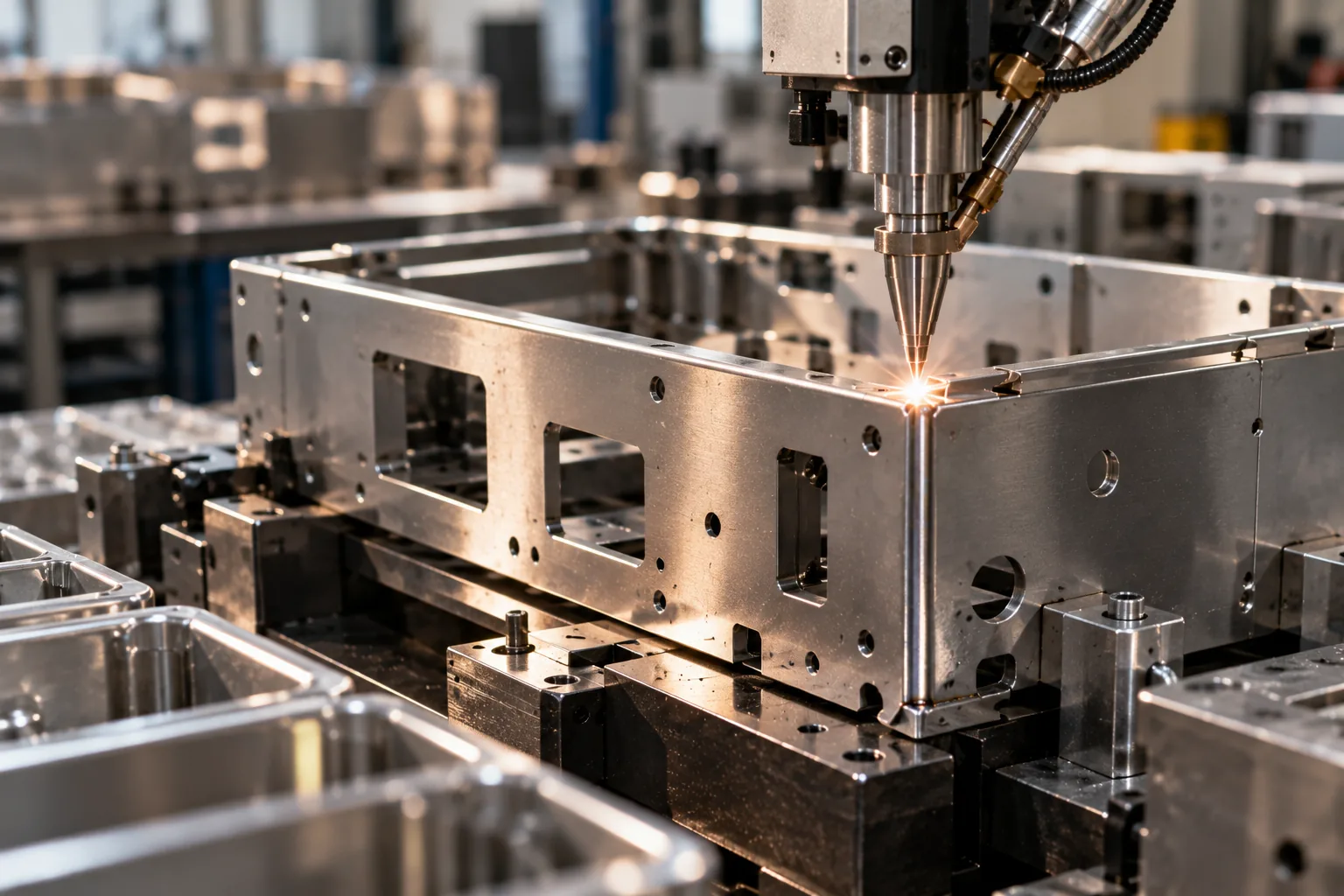
Laser welding fuses sheet metal with a concentrated beam that produces a deep, narrow weld at high travel speed. Heat input is low enough to weld within millimetres of heat-sensitive components and to keep thin panels flat, which makes it the preferred process for sealed stainless enclosures and cosmetic assemblies.
Why choose laser welding over TIG?
Laser welding is 4–10 times faster and puts a fraction of the heat into the part, so distortion and discolouration are minimal and post-weld straightening is rarely needed. It also tolerates less fit-up error, so joint preparation has to be tighter. For one-off prototypes TIG is usually more economical; for repeat production laser wins.
Can laser welding seal an enclosure to IP67?
Yes. Because the weld is continuous rather than stitched, a laser seam can be made gas-tight, and the low heat input means gasket seats and nearby electronics stay within tolerance. We verify sealed assemblies with a leak or spray test matched to the specified IP rating before shipment.
Laser welding: capability window
| Parameter | Capability | Note |
|---|---|---|
| Material thickness | 0.2–3 mm | Thicker plate moves to TIG or MIG |
| Heat-affected zone | Very narrow | Can weld near sensitive components |
| Distortion | Minimal | Often no post-weld straightening needed |
| Weld speed | 4–10 × TIG | Strong advantage at repeat volume |
| Fit-up tolerance | Tight | Joint gaps must be small and consistent |
Common questions about Laser Welding
Does laser welding need filler wire?
Usually not. Autogenous laser welding fuses the parent metal with no filler, which is ideal for butt and lap joints on thin sheet. Where a joint has a deliberate gap or needs extra reinforcement, we can run the weld with filler wire and will say so on the process sheet.
Will the weld discolour stainless steel?
Far less than TIG, because the part spends far less time hot and shielding is effective. Any light heat tint is removed in passivation or electropolishing, which also restores corrosion resistance across the weld zone.
Can laser welded parts still be powder coated?
Yes. A laser seam is narrow and smooth, so it usually needs only light dressing before pretreatment. On stainless parts that will not be coated, we brush or electropolish the seam to match the surrounding finish.
Materials we run this process on
Related capabilities and next steps
Specifications
Capabilities
Laser vs Other Welding Methods
Multi-parameter comparison to help you choose the right joining method for your application.
| Parameter | Laser | TIG (GTAW) | MIG (GMAW) | Spot (RSW) |
|---|---|---|---|---|
| Welding Speed | Very fast — 10–5000 mm/min | Slow — manual pace, 50–300 mm/min | Moderate — 1000–3000 mm/min | Very fast — 0.1–0.5 s/spot |
| HAZ Width | Ultra-narrow — <1 mm | Narrow — 1–2 mm | Moderate — 3–5 mm | Very narrow — <1 mm |
| Distortion | Minimal | Low | Moderate | Very low |
| Filler Material | None | Optional | Required | None |
| Automation | Fully automated | Manual / semi-auto | Semi-auto / auto | Fully automated |
| Appearance | Excellent — cosmetic seam | Excellent — smooth stacked-dime bead | Good — minor ripples | Limited — spot marks only |
| Best For | Precision enclosures, thin-wall parts | Food-grade, sanitary, visible joints | High-speed structural welds | High-volume sheet assemblies |
Sheet metal engineering guides
 Laser Cutting vs CNC Punching: When to Use WhichFiber laser excels at complex contours and thin sheets; turret punching wins on high-volume repeatability with formed features. Here is how to decide.Read More
 DFM for Sheet Metal: Essential Design Rules That Save Cost and Prevent Production FailuresDesign-for-manufacturing rules for sheet metal — minimum hole sizes, bend radii, edge distances, tab-and-slot design, and common mistakes that cause scrap.Read More
Ready to get started?
Upload your design for a quote with DFM analysis — our engineers respond within 24 hours.