
Fine Blanking
Fine blanking holds the material under triple-action pressure while it is cut, producing a fully sheared, square edge with no fracture zone and no burr. Parts leave the press ready for assembly, which removes the secondary machining, grinding or deburring that conventional blanking needs on functional edges.
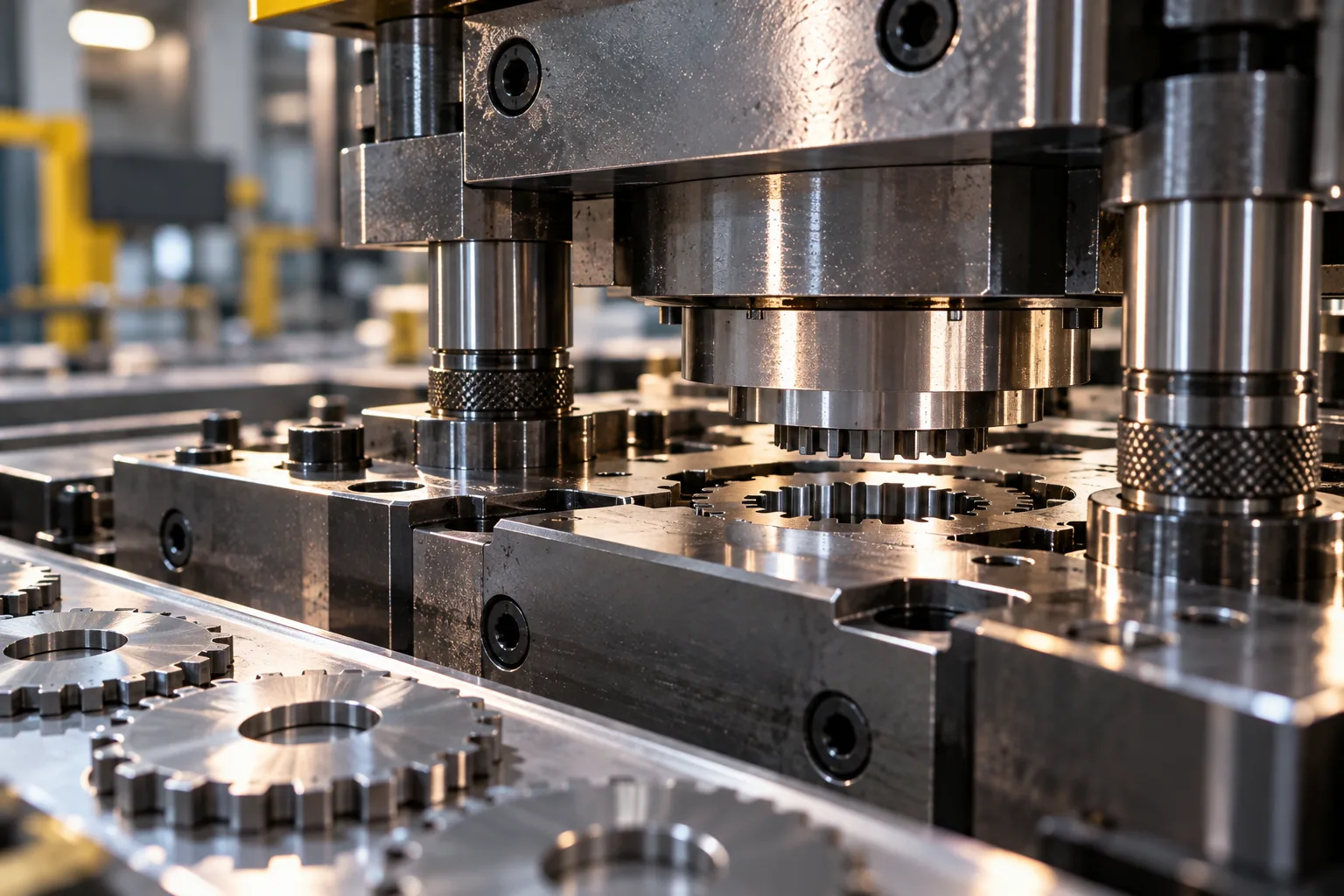
Fine blanking is a precision stamping process that holds the material under triple-action pressure during cutting, producing a fully sheared, square edge with no fracture zone and no burr. Parts come off the press ready for assembly, which removes the secondary machining, grinding or deburring that conventional blanking requires.
When is fine blanking worth the extra tooling cost?
When a blanked edge is a functional surface. Gear teeth, cam profiles, bearing surfaces, ratchet geometries and mating faces normally need machining after conventional blanking; fine blanking delivers the finished edge directly. If the edge is non-functional, conventional blanking is cheaper and there is no reason to pay for fine blanking.
What tolerances does fine blanking hold?
Fine blanking routinely holds dimensional tolerances in the region of ±0.01 to ±0.05 mm with surface finishes well under one micron Ra on the sheared face. That is why it replaces machining on many flat precision components, particularly in automotive and mechanism applications.
Fine blanking vs conventional blanking
| Factor | Fine blanking | Conventional blanking |
|---|---|---|
| Cut edge | Fully sheared, square, burr-free | Fracture zone and burr |
| Dimensional tolerance | ±0.01–0.05 mm | Looser, depends on clearance |
| Secondary machining | Usually eliminated | Often required on functional edges |
| Tooling cost | Higher | Lower |
| Typical parts | Gears, cams, ratchets, bearing faces | Non-functional edge parts |
Common questions about Fine Blanking
Does fine blanking work on all materials?
It works best on materials with good cold-formability — low and medium carbon steels, many stainless grades and aluminium alloys. High-strength and brittle materials shear poorly and may still need machining. Send your material specification and we will confirm suitability.
Can fine blanked parts be heat treated afterwards?
Yes, and they commonly are. Fine blanked components are frequently carburised, hardened or nitrided after blanking. We factor any post-blanking heat treatment into the dimensional plan so the finished part still lands inside tolerance after treatment.
Is there a minimum quantity for fine blanking?
Fine blanking tooling is more expensive than conventional blanking tooling, so it is normally justified from around 5,000 parts upward. Below that we can often achieve the required edge quality with conventional blanking plus a light machining pass, and we will quote both.
Materials we run this process on
Related capabilities and next steps
Specifications
Capabilities
Sheet metal engineering guides
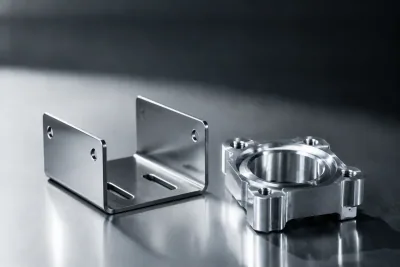 Sheet Metal Fabrication vs CNC Machining: How to Choose the Right ProcessSheet metal fabrication and CNC machining serve different geometries, volumes, and budgets. This data-backed comparison covers cost, tolerance, materials, and lead time.Read More
 How Sheet Metal Quoting Works: A Complete Cost Breakdown for BuyersUnderstanding how sheet metal quotes are calculated helps you negotiate smarter, compare suppliers fairly, and reduce per-part cost.Read More
Ready to get started?
Upload your design for a quote with DFM analysis — our engineers respond within 24 hours.