
Progressive Die Stamping
A coil or strip feeds through a single die with a station per operation, producing one finished part per press stroke. Because every station works on every stroke, output reaches up to 200 strokes per minute with ±0.01 mm positional repeatability — the lowest unit cost of any forming method we run.
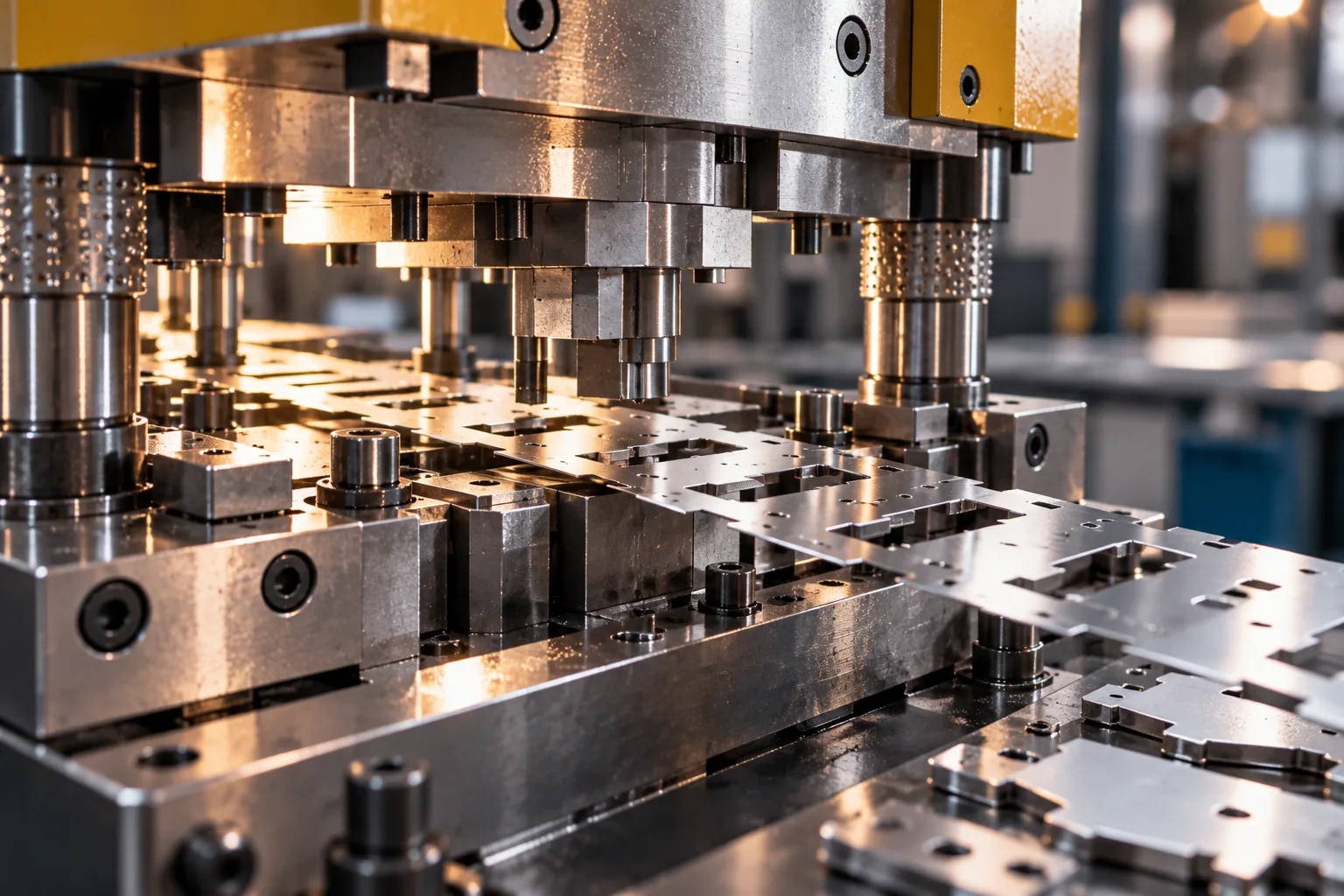
Progressive die stamping feeds a coil or strip through a single die with a series of stations, each performing one operation per press stroke. Every stroke produces a finished part, so the process runs unattended at high speed with ±0.01 mm repeatability. It is the highest-volume, lowest-unit-cost forming method we operate.
How does a progressive die differ from other stamping dies?
The part stays attached to a carrier strip and moves through stations that pierce, notch, form, coin and finally cut it free. Because every station works on every stroke, output is one finished part per stroke. A transfer die instead moves individual blanks between stations, which suits parts too large or too deep to stay on a strip.
What makes a part suitable for progressive die stamping?
Parts under roughly 300 mm, made from coil, with features that can be formed while attached to a carrier. Very deep draws, parts needing rotation between operations, and very small batches all favour a different method. We confirm suitability during die design, before any steel is cut.
Progressive die stamping: capability and economics
| Parameter | Typical value | Note |
|---|---|---|
| Positional tolerance | ±0.01 mm | On pierced hole positions |
| Formed feature tolerance | ±0.05 mm | Depends on material and feature size |
| Press speed | Up to 200 strokes/min | One finished part per stroke |
| Die life | Up to 1,000,000 strokes | Maintenance included in programme |
| Economic volume | 10,000+ parts | Below this, laser-cut-and-bend is cheaper |
Common questions about Progressive Die Stamping
What is the minimum order quantity for progressive die stamping?
There is no formal MOQ, but the tooling cost has to be amortised, so progressive die stamping rarely makes sense below about 10,000 parts. Below that we quote laser cutting and CNC bending, which needs no tooling, and we will show both numbers side by side when you ask.
Can a progressive die produce formed features as well as flat blanks?
Yes. Bends, ribs, extruded holes, coined features and threads can all be formed in-line. That is the main reason progressive dies replace multi-operation CNC routes at volume: a single press produces a finished part instead of a blank that then needs bending, hardware and welding.
How do you maintain dimensional consistency over a long run?
The die is built with wear allowance and inspected on a planned stroke count, and first-off and last-off parts from each run are dimensionally checked. Because we build and maintain the die in-house, wear is corrected before it shows up as out-of-tolerance parts.
Materials we run this process on
Related capabilities and next steps
Specifications
Capabilities
Ready to get started?
Upload your design for a quote with DFM analysis — our engineers respond within 24 hours.