
Transfer Die Stamping
A mechanical transfer system moves individual blanks between stations instead of feeding them on a carrier strip. That freedom suits parts too large, too deep or too complex to stay attached to a strip — deep-drawn housings, large chassis panels and parts needing re-orientation between operations.
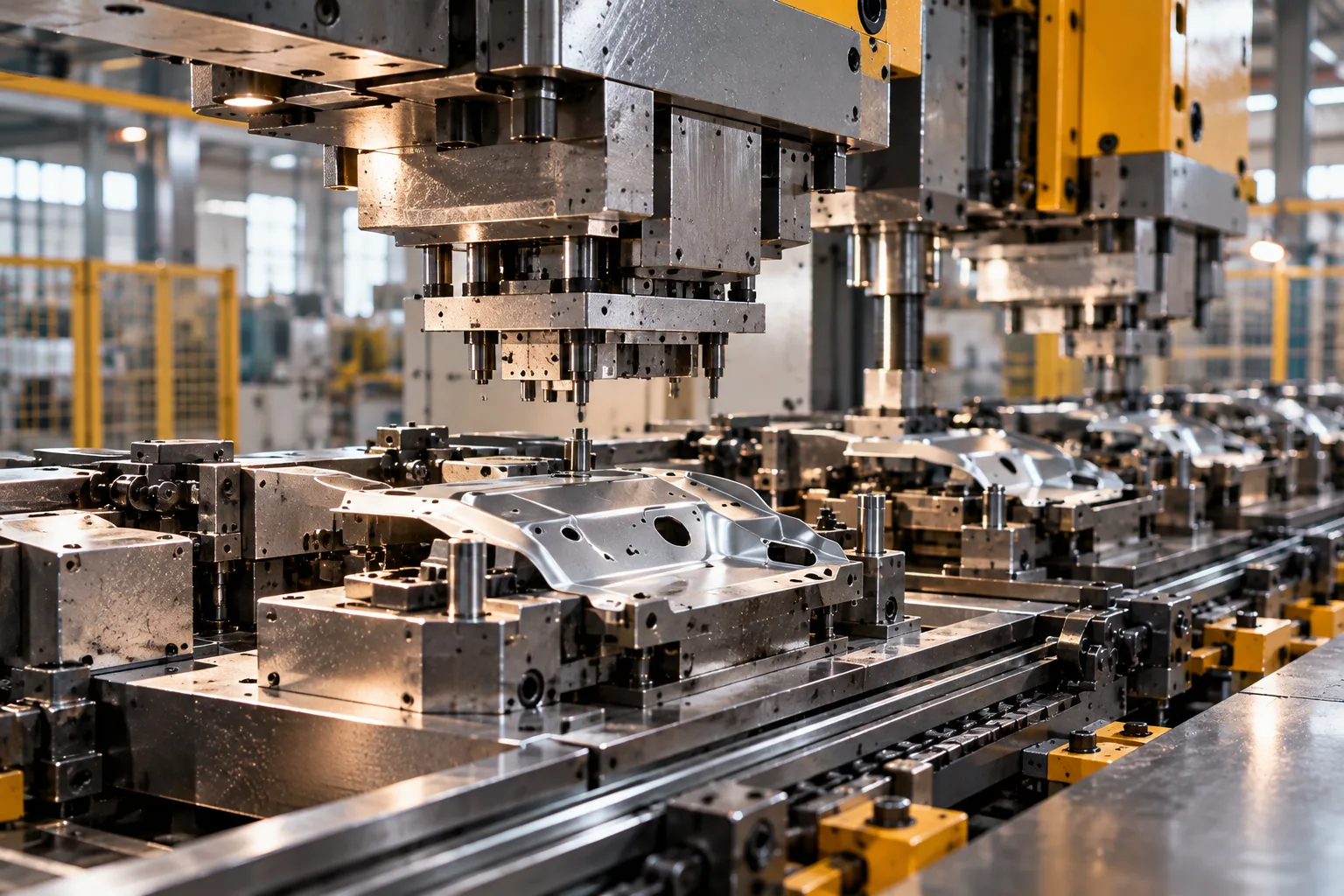
Transfer die stamping moves individual blanks between stations with a mechanical transfer system rather than feeding them on a carrier strip. That freedom suits parts that are too large, too deep or too complex to stay attached to a strip — deep-drawn housings, large chassis panels and parts needing rotation between operations.
When is a transfer die the right choice?
When the part cannot survive on a carrier strip. Deep draws, large panels and parts that must be turned or re-oriented between operations all exceed what a progressive die can hold. The trade-off is speed: transfer systems are slower per part than a strip-fed progressive die, so unit cost is higher at equivalent volume.
Can a transfer die combine drawing and piercing?
Yes. A single transfer line can draw, redraw, trim, pierce and flange in sequence, which removes several separate setups. That is what makes transfer die stamping economical for complex housings that would otherwise need a press, a laser and a brake to produce.
Transfer die vs progressive die
| Factor | Transfer die | Progressive die |
|---|---|---|
| Part size | Large parts | Small to medium parts |
| Part depth | Deep draws possible | Limited by carrier strip |
| Re-orientation between stations | Yes | No |
| Cycle speed | Slower | Faster |
| Typical volume | 5,000+ | 10,000+ |
Common questions about Transfer Die Stamping
What size of part can a transfer die handle?
Transfer systems handle parts well beyond the practical limit of a progressive die, including large chassis panels and deep housings. The exact envelope depends on press bed and transfer reach; send your model and we will confirm feasibility against our press line specifications.
Is transfer die stamping more expensive?
Per part, usually yes, because the cycle is slower than a strip-fed press. It is still cheaper than the alternative route of drawing on one machine, trimming on a laser and forming on a brake. We quote both when the geometry allows either approach.
Do you build transfer dies in-house?
Yes. Our die shop designs, builds, trials and maintains transfer dies, which typically shortens tooling lead time by 30–50 percent compared with outsourced tooling and makes design changes during validation far quicker to turn around.
Materials we run this process on
Related capabilities and next steps
Specifications
Capabilities
Sheet metal engineering guides
 Sheet Metal Fabrication vs CNC Machining: How to Choose the Right ProcessSheet metal fabrication and CNC machining serve different geometries, volumes, and budgets. This data-backed comparison covers cost, tolerance, materials, and lead time.Read More
 8 Proven Ways to Cut Sheet Metal Costs Without Sacrificing QualityFrom bend radius optimization to material nesting — eight actionable design and sourcing strategies that reduce cost while maintaining part performance.Read More
Ready to get started?
Upload your design for a quote with DFM analysis — our engineers respond within 24 hours.