
Precision Shearing
Guillotine and swing-beam shearing machines produce clean, straight cuts on large sheet blanks prior to secondary forming operations. Our CNC shears deliver burr-free edges with minimal kerf loss, ensuring material utilization stays high across production batches.
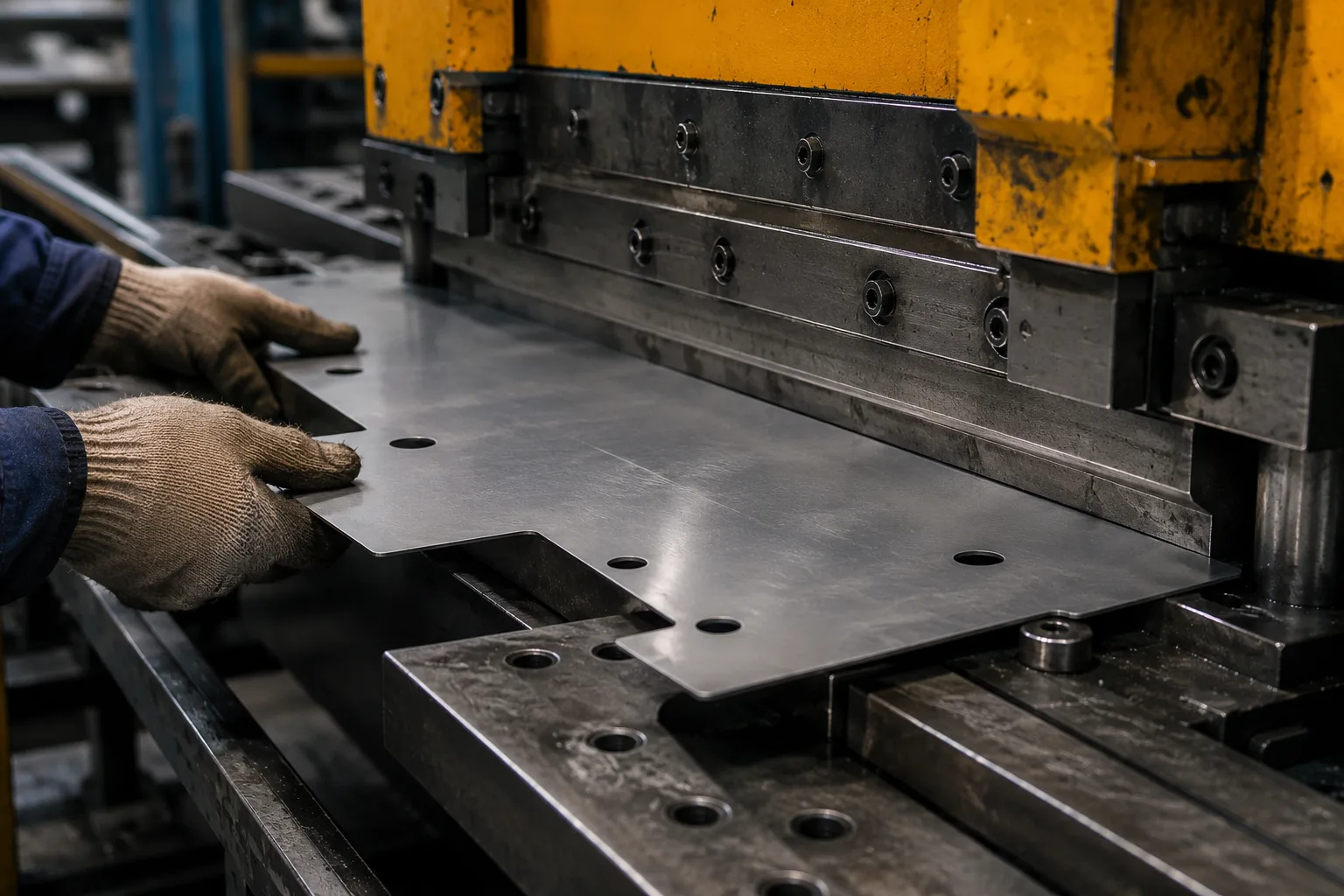
Shearing cuts sheet metal in a straight line by driving a moving blade past a fixed blade, with no heat and no material loss to a kerf. It is the fastest and cheapest way to square up a blank or cut simple rectangles, and it is used upstream of bending, punching and laser cutting rather than for complex profiles.
When should I use shearing instead of laser cutting?
Use shearing when the cut is straight and the quantity justifies a setup. A shear produces a blank in seconds at near-zero marginal cost, where a laser would spend minutes tracing the same line. The moment the profile includes a curve, a notch or an internal hole, the job belongs on the laser or the punch.
Does shearing affect downstream bending?
It can. Shearing work-hardens and slightly rolls the cut edge, which makes the outer fibres less ductile. On alloys that already bend close to their limit, we place the shear line away from the bend zone or switch the blank to laser. Your engineer checks this before the blank is released.
Shearing vs fiber laser cutting: where each one wins
| Factor | Shearing | Fiber laser |
|---|---|---|
| Cut geometry | Straight lines only | Any 2D contour |
| Material lost to kerf | None | 0.1–0.3 mm |
| Cycle time per blank | Seconds | Minutes |
| Edge work hardening | Moderate | Heat-affected zone instead |
| Typical use | Squaring blanks, simple strips | Finished profiles, holes, slots |
Common questions about Precision Shearing
How accurate is a sheared cut?
Shearing holds roughly ±0.2–0.5 mm depending on thickness and machine condition, which is looser than laser but sufficient for blanks that will be formed or machined afterwards. Where a sheared edge is a finished dimension, we laser cut it instead and say so on the quote.
Will shearing leave a burr?
Yes — a shear always leaves a small burr on the underside of the cut. We deburr before the part moves downstream, and we confirm at quote stage whether deburring is included in the unit price or listed separately.
What is the maximum length you can shear?
Standard shear beds handle full-size sheets up to 3,000 mm. Longer or heavier plate is cut on the laser or by saw. Include the blank size in your RFQ and we will route it to the right machine.
Materials we run this process on
Related capabilities and next steps
Specifications
Capabilities
Sheet metal engineering guides
 8 Proven Ways to Cut Sheet Metal Costs Without Sacrificing QualityFrom bend radius optimization to material nesting — eight actionable design and sourcing strategies that reduce cost while maintaining part performance.Read More
 Laser Cutting vs CNC Punching: When to Use WhichFiber laser excels at complex contours and thin sheets; turret punching wins on high-volume repeatability with formed features. Here is how to decide.Read More
Ready to get started?
Upload your design for a quote with DFM analysis — our engineers respond within 24 hours.