
Fiber Laser Cutting
Dual-pallet exchange table automation paired with DNE 3000W and Hans Laser 6000W fiber lasers. We cut burr-free profiles in stainless steel, aluminum, brass, and carbon steel with minimal thermal distortion. Thin sheet produces near-mirror edges requiring no secondary finishing; thicker gauges may need minor deburring.
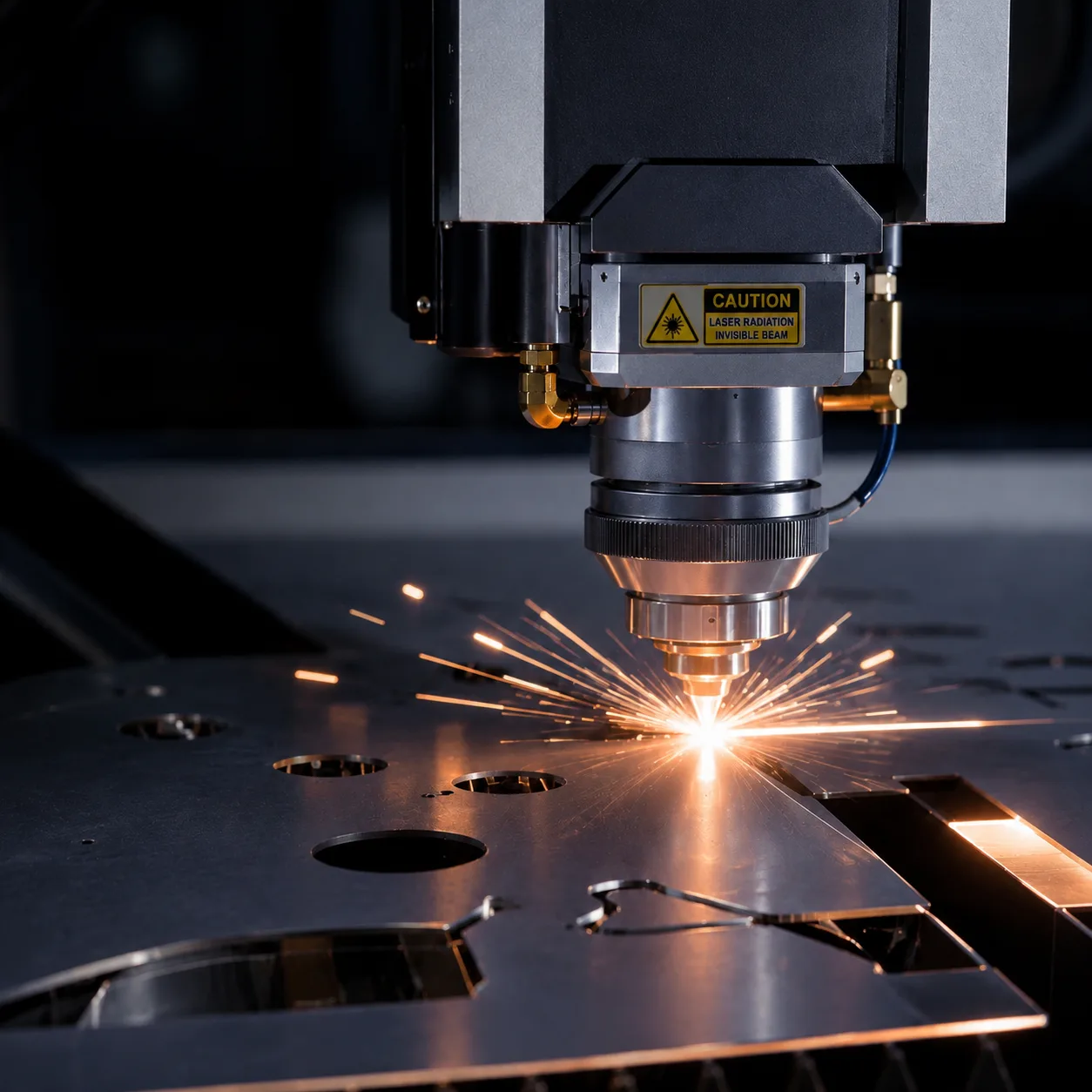
Fiber laser cutting is a CNC process that cuts sheet metal with a focused 6 kW beam, holding ±0.1 mm positional accuracy on material from 0.3 mm to 5.0 mm thick. It needs no hard tooling, making it the lowest-cost route for prototypes and low-to-mid volumes, and it leaves burr-free edges that usually skip deburring.
What thickness can a fiber laser cut?
Our production window is 0.3 mm to 5.0 mm on a 1500 × 3000 mm bed. Thin gauge stainless and aluminium cut with a near-mirror edge and a kerf of roughly 0.1–0.3 mm. Above about 4 mm the heat-affected zone grows and edge squareness drops, so we flag parts in that range for a DFM review before quoting.
When is laser cutting cheaper than CNC punching?
Laser wins on complex contours, small batches and any design that will still change, because there is no tooling to amortise. Punching takes over once a profile repeats at volume and needs formed features such as louvers or extruded holes. For a flat bracket with three holes, the crossover usually sits near 800–1,500 parts.
Fiber laser cutting: design rules we check in every DFM review
| Design rule | Recommended value | Why it matters |
|---|---|---|
| Minimum hole diameter | ≥ 1.0 × material thickness | Smaller holes produce tapered walls and dross |
| Minimum web (material between cuts) | ≥ 1.0 × material thickness | Narrow webs distort from heat and lose flatness |
| Minimum slot width | ≥ 1.0 × material thickness | Thin slots warp and drift out of tolerance |
| Hole-to-edge distance | ≥ 2.0 × material thickness | Prevents edge bulge and part distortion |
| Standard cut tolerance | ±0.1 mm | Held on all CNC sheet metal parts as standard |
Common questions about Fiber Laser Cutting
Does laser cutting leave a burr that needs deburring?
On material up to roughly 3 mm the edge is normally clean enough to ship as-cut. Thicker plate can build a small amount of dross on the underside, which we remove with a deburring pass. We tell you at quote stage whether deburring is included, so it never appears as a line-item surprise.
Can you cut reflective metals like copper and brass?
Yes, but the window is narrower than for steel. Copper and brass reflect far more of the beam back into the optics, so we run them at reduced thickness and adjusted parameters. Send the material and gauge with your RFQ and we will confirm feasibility within 24 hours.
What file format should I upload for laser cutting?
A DXF flat pattern is ideal; STEP or DWG also work. If you only have a 3D model, our engineers generate the flat pattern with the correct bend allowance and K-factor for your material, then send it back for approval before cutting.
Materials we run this process on
Related capabilities and next steps
Specifications
Capabilities
Sheet metal engineering guides
 Laser Cutting vs CNC Punching: When to Use WhichFiber laser excels at complex contours and thin sheets; turret punching wins on high-volume repeatability with formed features. Here is how to decide.Read More
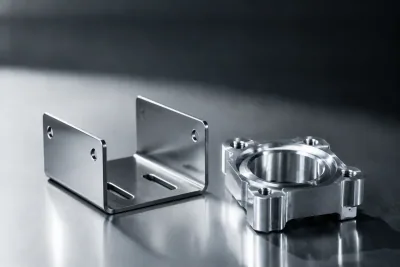 Sheet Metal Fabrication vs CNC Machining: How to Choose the Right ProcessSheet metal fabrication and CNC machining serve different geometries, volumes, and budgets. This data-backed comparison covers cost, tolerance, materials, and lead time.Read More
Ready to get started?
Upload your design for a quote with DFM analysis — our engineers respond within 24 hours.