
CNC Turret Punching
High-speed turret punching stations rapidly create holes, louvers, forming features, and complex cutouts in sheet metal. Ideal for high-volume sheet metal parts requiring numerous identical hole patterns and formed features without laser thermal effects.
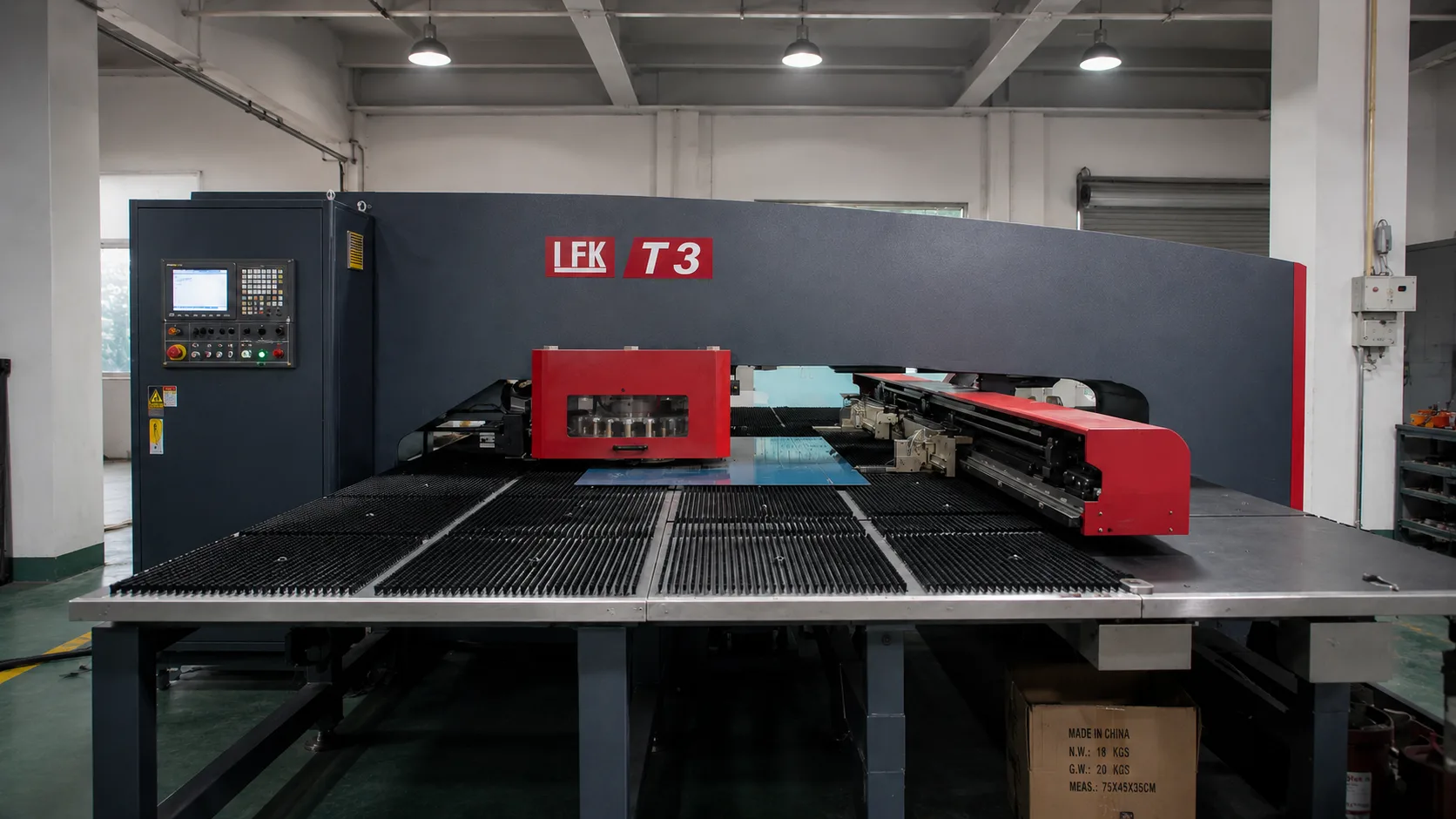
CNC turret punching forms sheet metal by driving standard tooling through the sheet at up to 500 hits per minute. Once a profile is set up it is faster per part than laser cutting and can create 3D features a laser cannot — louvers, extruded holes, countersinks and embossments — but it needs tooling setup time.
What can a turret punch do that a laser cannot?
Punching forms material rather than only removing it. Louvers, lanced vents, extruded threaded holes, countersinks, card guides and stiffening ribs are all single-stroke operations. A fiber laser produces none of these, so parts that combine a flat profile with formed features usually run on the punch and then move to the press brake.
Is CNC punching cost-effective for prototypes?
Usually not. Programming plus tooling setup adds 1–2 days before the first part, which makes laser cutting the cheaper choice below a few hundred pieces. Punching becomes the lower unit cost once the profile repeats enough times to amortise that setup across the run.
CNC turret punching: capability and design limits
| Parameter | Capability | Note |
|---|---|---|
| Hit rate | Up to 500 hits/min | Cycle time is driven by hits, not part size |
| Tool stations | Up to 72 tools | Multi-tool parts run in a single setup |
| Minimum hole diameter | 1.2 × material thickness | Below this, tool life falls sharply |
| Minimum web width | 1.5 × material thickness | Narrow webs deform under punch load |
| Formed features | Louvers, extrusions, embosses | Not achievable with laser cutting |
Common questions about CNC Turret Punching
How thin can the material be before punching causes distortion?
Below roughly 0.5 mm the sheet tends to pull and deform around the punch, especially near part edges. For thin-gauge work we usually recommend laser cutting instead, or we adjust the tool clearance and add support. Your engineer will flag it during DFM review.
Do I pay for tooling on a punching order?
Standard round, square and obround tools are already in the turret and carry no charge. Only non-standard shapes need a custom tool, and we quote that separately and tell you the part quantity at which the tooling pays for itself.
Can punching and laser cutting be combined on one part?
Yes, and it is often the cheapest route. We cut complex outer contours on the laser, then form louvers and extruded holes on the punch, or the reverse. Sequencing is decided during DFM so the part never pays for a process it does not need.
Materials we run this process on
Related capabilities and next steps
Specifications
Capabilities
Sheet metal engineering guides
 Laser Cutting vs CNC Punching: When to Use WhichFiber laser excels at complex contours and thin sheets; turret punching wins on high-volume repeatability with formed features. Here is how to decide.Read More
 8 Proven Ways to Cut Sheet Metal Costs Without Sacrificing QualityFrom bend radius optimization to material nesting — eight actionable design and sourcing strategies that reduce cost while maintaining part performance.Read More
Ready to get started?
Upload your design for a quote with DFM analysis — our engineers respond within 24 hours.